Importance of Head Height in Bidirectional Printing
So far, UV printer-related issues, We’ve compiled
- 24 articles about Ink supply issue
- 9 articles on basic head knowledge,
- 12 articles on actual head issues and solutions.
Related information can be found via links in the last section.
We’re currently discussing mechanical issues.
1. “I hear a clicking sound on the X-axis.”
2. “Bending occurs only in certain areas of the flatbed.”
Today, we’ll discuss the importance of head height in bidirectional printing.
I. Symptoms _Importance of Head Height in Bidirectional Printing
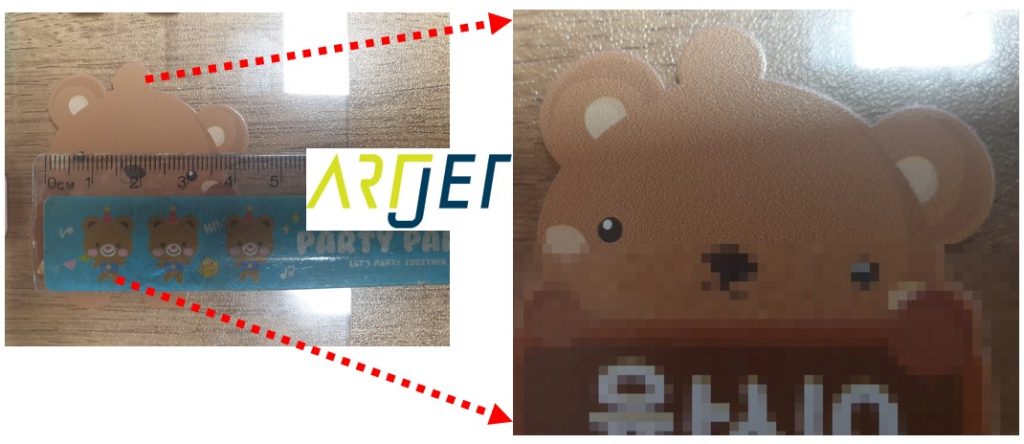
1. The image looks grainy _Importance of Head Height in Bidirectional Printing
There is bound to be a difference in image quality between unidirectional and bidirectional printing, but the image printed more coarsely than usual when bidirectional printing.
2. Print mode _Importance of Head Height in Bidirectional Printing
Importance of Head Height in Bidirectional Printing
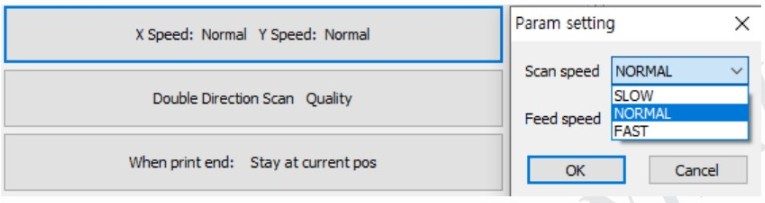
Head carriage speed and feed speed are both Normal
Printing direction: Double direction (bidirectional printing)
G mask: Quality mode
Full-face printing, i.e., color printing on white
II. Bidirectional printing roughness relief process _Importance of Head Height in Bidirectional Printing
1. Some assumptions and tests _Importance of Head Height in Bidirectional Printing
Question 1: When printing on the back (white over color), the dot mask is different from that used for full-page printing (color over white), resulting in a rougher image.
I compared the quality of full-page printing (color over white) with that of full-page printing (white over color), but the images were both rough.
Question 2: If I print thinly and reduce the density of the white, wouldn’t the uneven surface of the white be smoothed out, resulting in better image quality?
I tried adjusting the density of the white, but the image quality remained the same.
Question 3: Is the difference due to the acrylic height difference?
The acrylic is 1.55t, but some places are 1.51t, and others are 1.58t.
There was a difference of about 0.1mm, but the image roughness was consistent throughout.
Question 4: Is the print height too high? Should I lower it a bit or raise it a bit more?
Since the acrylic is 1.5mm thick, I entered the Z-axis height as 1.5mm and printed it.
I lowered the Z-axis height by 0.1mm to 1.4mm and raised it by 0.1mm to 1.6mm, but the image still came out rough.
No. 5 “It prints well on PET film, but why does the image look rough when I print only on acrylic?”
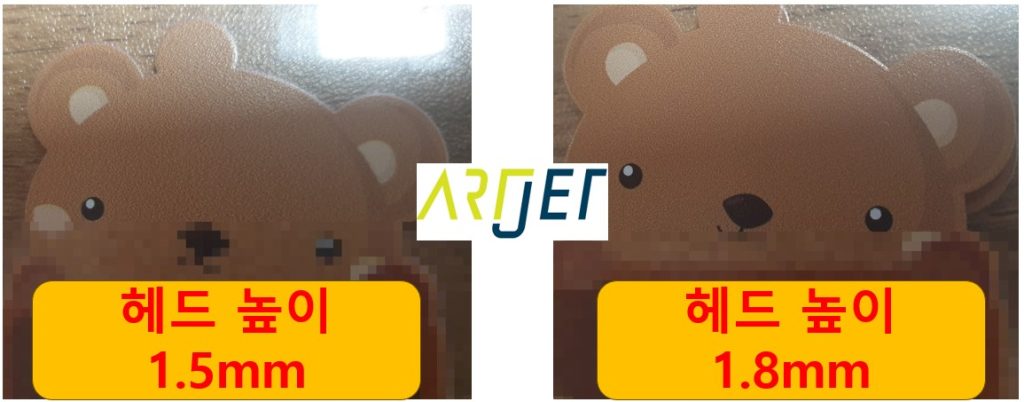
When I looked closely at images printed at different heights (1.4mm, 1.5mm, and 1.6mm) with a magnifying glass, I noticed that the edges of the letters were slightly double-printed.
Usually, the closer the gap between the material and the head, the better the bidirectional printing quality. The edges of the letters were better at 1.6mm than at 1.4mm.
Just in case, I printed at 1.7mm Z-axis height, and the letters printed even better.
When I increased the Z-axis height by 0.1mm to 1.8mm, the image quality improved, as shown in the photo below.
2. Precautions for bidirectional printing _Importance of Head Height in Bidirectional Printing
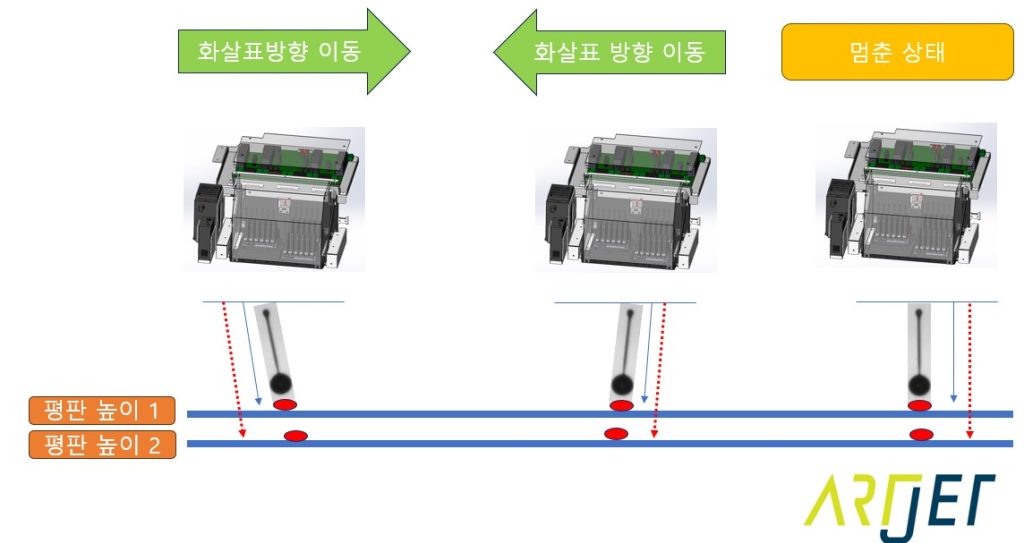
Verify that the gap between the material and the head is at the height set for the bidirectional offset.
Typically, the bidirectional offset is set at a 1.2mm gap between the material and the head. This gap is called the standoff.
Since the bidirectional offset is set at a standoff of 1.2mm, if the gap between the material and the head is 1.2mm during actual printing, the image will be rendered cleanly.
However, if the gap between the material and the head is not 1.2mm, the ink drop point will change, as shown in the image above, resulting in a rough image.
The reason the image was grainy when printed on 1.5mm acrylic was because:
- The initial standoff was set to 1.5mm, which is 0.3mm higher,
- and the actual print was printed with a standoff of 1.2mm.
- This resulted in a mismatch in the bidirectional offset values.
Why is the image rough in certain sections during bidirectional printing?
As seen in the troubleshooting process above, the image was produced smoothly when the standoff height was set to 1.8mm, which is 0.3mm higher than 1.5mm.
This means that even a 0.1mm or 0.2mm difference in standoff distance during bidirectional printing can affect image quality.
Because the flatness across the entire flatbed is not consistent, the standoff may be 1.2mm in some sections, but higher or lower than 1.2mm in other sections.
This is why the image is inevitably rough in certain sections during bidirectional printing.
If your image appears rougher than usual when printing bidirectionally, the easiest solution is to check the bidirectional offset value on the actual printing material before proceeding.
If the overall flatness of the platen section is not good, the image roughness may vary between sections. Please be aware of this before proceeding.
However, this does not mean that 4font text will be blurred.
III. This is how ARTJET supports our customers.
One thing I feel while selling and maintaining ARTJET UV Printers for 5 years is that the next most important thing after product stability is Troubleshooting DATA.
All products have problems, whether they are actual equipment problems or consumer errors, and product stability is how easily and quickly you solve those problems.
We are organizing all the troubleshooting DATA as follows.
You can see the product print quality by clicking here.

1. Complete Guide to Printhead Problems and Solutions
1st Summary
ARTJET UV Printer Problems and Solution _Printhead Problems Summary
Additional issue and solution
The red color does not appear at first, then appears during printing, and then does not appear again
Printhead replacement video and precautions
2nd Summary
I have summarized the basic knowledge about the head and the head problems that have occurred as follows.
Complete summary of actual head problems ARTJET 2025
2. Complete Guide to Ink Supply Problems and Solutions
Previously sorted, ink supply problem summary
2nd Summary
This is a summary of all the issues that have occurred over the past 5 years. If you have a printer that uses the Damper method, you can solve most problems by just looking at the link below.
If you go to the link, there are a total of 24 problems and solutions.
Complete summary of actual head problems ARTJET 2025
Addition
“no clogged nozzles, but banding in the red ARTJET 2025”
“When I print it, the whole thing has a yellow tint to it”
3. Mechanical problem and Solutions
1. How to align the print head in a straight line
2. There is a clicking noise from the X-axis
3. Banding problem in specific section
4. The Importance of Head Height in Bidirectional Printing
5. Problems that occur when the wiper height is high
6. When the cleaning belt screw is loose
7. When the capping fixing plate does not fit
8. How do I prepare the ARTJET electricity?
9.When Anti-crash becomes a jam in captop
10. Print head Anti crash system
4. Electron board and Software problem is hereunder.
1. The printer works but printing does not work
2. Resetting to default settings
3. Touch panel does not turn on
4. The printer is printing, but nothing is printed
5. Software closes when I just press the print button
6. Printing in the wrong place
7. Positioning misalignment in X-axis direction
8. How to make the Offset fine tune
9. Vertical offset is not correct only for the right section of white
10. Software turn off when click print button
5. Sai Flexi Rip software
1. How to make the Spot Color & several mistakes
2. Color is strange after applying Spot color
3. White is sticking out
4. Installation and Dongle Key Recognition Failure Measures
5. Dongle Key Recognition Failure
6. White lines appear when printing only color
7. Color Adjustment through Graph
8. Print size compensation
9. Ink Consumption Calculation
10. What is ICC profile & menu board UV Printing
11. Dongle Key recognition Failure from USB port
6. Problems and solutions from actual consumer sites
1. Paper that absorbs ink
2. A line-like thing appears at the end of the white print surface
3.Can varnish banding be reduced?
4. Are there many problems with China’s UV Printer?
7. UV Printer Application
we are explaining not only UV printer problems and solutions, but also what products are produced with UV printers.
1. Braille printing
2. Flip the material and align it
3. 2.5D UV print
4. ARTJET UV Printer Application 6 _아크릴 본딩 장비
5. I phone 14 print limitation
6. Mask printing not recommend
7. Leather Cigarette Case UV Printing
8. Round soccer strategy board UV printing
9. Primer performance & limitation
10. UV Print & Laser crop mark cutting
11. Mobil case UV print profit
12. Screen vs Digital Comparison and UV Printing on Hand Sanitizer Cases
13. Bottle zig & print
14. Canvas UV Printing
15. Applying epoxy effect with varnish
16. Making a light frame with UV Printer & Laser cutter
17. UV Printer & Laser Cutting Equipment Button Name Tag Making
18. UV Printer & Laser Cutting Making a Cell Phone GripTok
19. Making an Acrylic Keychain with UV Printer & Laser Cutter
20. UV Print with Zig
21. How to make RD WORKS CCD camera cutting Video manual
22. Acrylic bonding equipment
23. All the steps to create UVDTF
24. UVDTF TEST Result on various material
25. ARTJET CW+C Print time & Ink Cost
26. Create a white shield with different images on the front and back of the keyring
27. Keyring Business Required Equipment and Investment Costs
29. Acrylic Lighting Goods
30. Ballpoint pen jig printing
31. Staining occurs when printing on coated leather
8. Bonus
1. ARTJET UV Printer Old Model Refurbished
2. UV Printer Laser Cutter Bonding Machine Which equipment should I buy first?
3. Considerations when choosing a UV printer
4. DTF Printer Price and Specification Survey
5. Acrylic Bonding Equipment Don’t Put It Off Anymore
6. China inkjet level now
7. Thoughts on KOSIGN 2024
8. ARTJET Delivery Preparation
9. ARTJET Setting Sequence
10. UV Printer History and Future Prediction 1
11. UV Printer History and Future Prediction 2
12. UV Printer History and Future Prediction 3
13. UV Printer History and Future Prediction 4
14. UV Printer History and Future Prediction 5
15. Are there many problems with China’s UV Printer?
16. UV Printer Small Text Meaning
17. Is the XP600 head okay
18. Roland UV Printer Summary
19. Mimaki UV Printer Summary
20. UV Printer Alibaba Direct Purchase Considerations
21. Things to consider when buying a used UV Printer
22. Bi Uni Print Quality Differences
23. RDworks download install and laser head position by SW
That’s it for today.
핑백: Following actions do not work when connecting SW ARTJET 2025
핑백: When Bidirectional offset is completely off ARTJET 2025
핑백: Head crash message won't go away ARTJET 2025
핑백: When Anti crash sensor is jammed in the Captop ARTJET 2025