Konica print head model name meaning — Printhead Basics (Part 10)
✅ Who Should Read This
- Anyone confused by Konica print head model names like KM1024i or KM1800i
- Anyone wondering what each number and letter in a model name actually means
- Anyone who wants to understand the difference between Shared wall and Independent drive structures
- Anyone curious about Konica’s newer head trends, including MEMS and KM800/1600 series
⚠️ Precautions
- The pico liter ranges (S: 6pl or less, M: 12–14pl, L: 30pl or more) apply to the i-series; for older heads like the 512LH and 1024LH, L indicates 42pl
- The MEMS head and KM800/1600 series have not yet been sufficiently verified for field stability
- Before adopting any new head, always confirm real-world usage cases and stability from other printer manufacturers first
🧭 Key Summary (Field Insight)
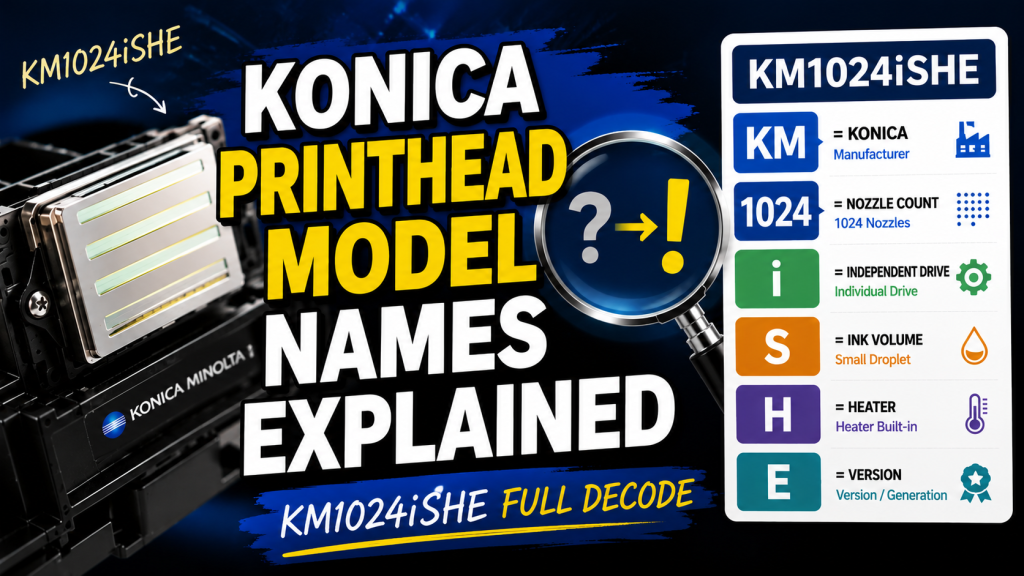
- Konica model names follow a clear pattern — KM (manufacturer) + number (nozzle count) + i (Independent) + S/M/L (ink drop volume) + H (built-in heater)
- The presence or absence of “i” is the key — Independent drive offers higher jetting frequency and better stability than Shared wall
- Head development trends: increasing nozzle count (512→1800), higher NPI (360→600npi), and a shift toward Bending mode
- MEMS and KM800/1600 series remain unverified in the field — confirm stability before adopting any new head
UV Printer Basics · Troubleshooting · Product Guides
We have organized our UV Printer content below. Click an item to read the full post.
1) Ink Supply
23 articles on ink supply issues, including cleaning and pumping
2) Print Head Issues
12 articles on head-related problems, from replacement methods to symptoms
For deeper printhead study: Printhead Basics — 10 Articles
3) Electronics / Software Issues
4) Mechanical Issues
5) Sai Flexi RIP Installation, Spot Color, Troubleshooting
6) UV Printable Products — Full Summary
📋 Printhead Basics — Full Series List
We are documenting printhead fundamentals in order. This list is updated with each new part.
10What Konica Print Head Model Names Mean
Many printer users — and even service engineers — hold misconceptions about print heads, so we would like to explain the fundamentals of printhead knowledge.
Today, we explain what models Konica offers and what the letters and numbers in each model name mean.
It may seem confusing at first, but once you understand a few terms and concepts, it all starts to make sense.
I. What the Letters in Konica Head Model Names Mean – Konica print head model name meaning
1. What “i” Means in KM1024 vs. KM1024i

1_1. The Shared Wall Structure — Nozzles That Jetting Together
- Early Konica print heads did not operate each nozzle independently. Instead, they used shared walls between nozzles, causing them to influence one another.
- This is the Shared wall structure shown on the left side of the diagram above.
- When one nozzle jets ink, the nozzle directly next to it must wait and cannot fire at the same time.
- Only after the adjacent nozzle finishes jetting can the next nozzle take its turn.
- This linked operation creates several disadvantages.
- Each nozzle must wait its turn, meaning ink is not being fired during that wait time.
- In other words, when moving quickly along the X axis to achieve high resolution, the Shared wall structure requires a lower carriage speed — because of the built-in wait time — in order to produce high-dpi output.
- Additionally, after the wall moves to jet ink, it must come to a complete stop before moving again for the next jetting cycle.
- If this doesn’t happen, ink may be jetted before the chamber is fully refilled, causing the drop to break into smaller satellite droplets.
- Or the wall may still be vibrating slightly when voltage is applied again, resulting in imprecise movement and ink drops that don’t fall perfectly vertical.
1_2. The Independent Drive Structure — No Waiting Required
- With Independent drive, there is no need to wait for adjacent walls to stabilize, so each nozzle can fire more frequently within the same time window. Ink output per unit time naturally increases.
- Compared to Shared wall, the carriage can move at the same X-axis speed while achieving a higher dpi — meaning faster printing.
- By the same logic, running the carriage at the same speed as a Shared wall head still yields higher dpi output.
- And because each nozzle is unaffected by the micro-vibrations of adjacent walls, jetting is more stable than with Shared wall structures.
- Today, virtually all Konica print heads use Independent drive rather than Shared wall.
- If you see the letter [ i ] in a Konica head model name, think of it as standing for Independent.
2. What the Other Letters Mean

2_1. The Basic Naming Convention
- KM stands for Konica Minolta.
- The number that follows — such as 1024 — is the total nozzle count. 512 means 512 nozzles, 1024 means 1,024 nozzles, and 1800 means 1,800 nozzles.
- The letters after the number — SHB, MHE, LHE — indicate ink drop volume. S (Small) means approximately 6pl or less; M (Middle) means 12–14pl; L (Large) means 30pl or more for i-series heads. However, for older heads like the 512LH and 1024LH, L indicates 42pl.
- The letter H — as in SHB, MHE, LHE — stands for Heater. A model with H has a built-in heater inside the head for warming ink. The 4th and 5th models in the photo above — KM1024iMAE-C and KM1024iSAE-C — have no H, and their spec sheets confirm “No” under the built-in heater section.
2_2. Putting It Into Practice
- Let’s decode the model name KM1800iSHC-C:
- KM: Konica Minolta
- 1800: 1,800 nozzles
- i: Independent drive — nozzles operate independently, resulting in high jetting frequency
- S: Small drop volume — 6pl or less
- H: Built-in heater
As you can see, just reading the letters in a Konica model name gives you a solid picture of what the head is.
II. Konica Head Trends – Konica print head model name meaning
1. Head Development Direction

- This chart shows the development trends for Konica heads.
- Heads are growing physically larger, with total nozzle counts increasing from 512 to 1,800 — driven by goals of higher print speeds and single-pass capability.
- The structure has shifted from Shared wall to Independent drive, and jetting frequency continues to rise — pointing toward higher resolution output.
- NPI (nozzles per inch), which determines native Y-axis resolution, is also trending upward from 360 to 600npi.
2. Notable Points
- Models up through the 512, 1024, and 1800 used Shear mode. Starting with the MEMS head, Konica transitioned to Bending mode.
- Whether the MEMS model has reached stable, widespread field use is still unclear.
- Shear mode was explained above. Bending mode pushes ink downward from above to eject it — generally considered a more stable jetting method than Shear mode.
- The diagram below illustrates the difference.
-

Konica print head model name meaning - According to Konica’s promotional materials, the key improvements are as follows:
- Nozzle plate changed from film to metal or plastic — improved durability
- Shift from Shear mode to Bending mode — improved jetting stability and performance
- Improved jetting angle and ink drop straightness
- Wider ink acidity range now supported due to the metal or plastic nozzle plate
- When we recently checked Konica’s latest documentation, the MEMS model name no longer appeared — instead, the KM800 and KM1600 series were listed as new additions.
- Whenever a new head is released, always verify whether it has stabilized in the field — check whether other printer manufacturers are using the same head, and confirm its stability and performance before deciding to adopt it.
- Just as Ricoh’s Gen5i head — despite its excellent print quality — has never been mass-produced due to durability concerns, Konica’s KM1800i, originally developed for single-pass use, also had jetting stability issues. Whether those have been resolved is unclear.
III. ARTJET UV Printer
After selling and maintaining ARTJET UV printers for over 5 years, we have learned one vital lesson.
The most important factor next to product stability is accumulating troubleshooting data.
Problems can occur with any equipment depending on the environment, working conditions, and user skill level. What matters in the field is not “trouble-free equipment,” but:
How fast and how accurately you can find the cause and solve the problem when it occurs.
ARTJET continuously collects and organizes real-world problem data from the field to support faster and more accurate problem resolution.
🎥 View Print Quality Samples
🧾 Full List of UV Printable Products

* Note: Exterior design has been updated.
※ This article is based on actual field cases. Results may vary depending on the environment and equipment configuration.
핑백: Head problem Y-axis banding ARTJET 2025