How Ink Is Jetted from the Print Head — Printhead Basics (Part 1)
✅ Who Should Read This
- Those who want to understand how ink is jetted from a UV printer head
- Those wondering whether adding more heads improves print speed and quality
- Those deciding between high-end and budget print heads
⚠️ Precautions
- Adding heads in 2-row or 3-row configurations increases speed but may reduce print quality compared to a single-row arrangement
- Film-based head plates can suffer nozzle scratches that reduce jetting accuracy, while ceramic plates can crack under strong impact
- Heads are more often replaced due to poor maintenance (substrate collisions, UV curing clogs, etc.) than natural lifespan, so factor in replacement cost when choosing a head
🧭 Key Summary (Field Insight)
- There are two main ink jetting methods: Shear Wall (SII, KM, Toshiba) and Bend (Fujifilm Dimatix, Epson, Kyocera)
- Doubling speed by adding more heads while maintaining the same quality is practically very difficult — due to head alignment and nozzle offset issues
- High-end heads suit high-volume, experienced users; budget heads with lower replacement costs are the wiser choice for lower volumes or less experienced operators
UV Printer Basics · Troubleshooting · Product Guides
We have organized our UV Printer content below. Click an item to read the full post.
1) Ink Supply
23 articles on ink supply issues, including cleaning and pumping
2) Print Head Issues
12 articles on head-related problems, from replacement methods to symptoms
For deeper printhead study: Printhead Basics — 9 Articles
3) Electronics / Software Issues
4) Mechanical Issues
5) Sai Flexi RIP Installation, Spot Color, Troubleshooting
📋 Printhead Basics — Full Series List
We are documenting printhead fundamentals in order. This list is updated with each new part.
01How Ink Is Jetted from the Print Head
Many printer users — and even service engineers — hold misconceptions about print heads, so we would like to explain the fundamentals of printhead knowledge.
Today, as the first installment, we will start by explaining how ink is jetted from the head.
Today, as the first installment, we will start by explaining how ink is jetted from the head.
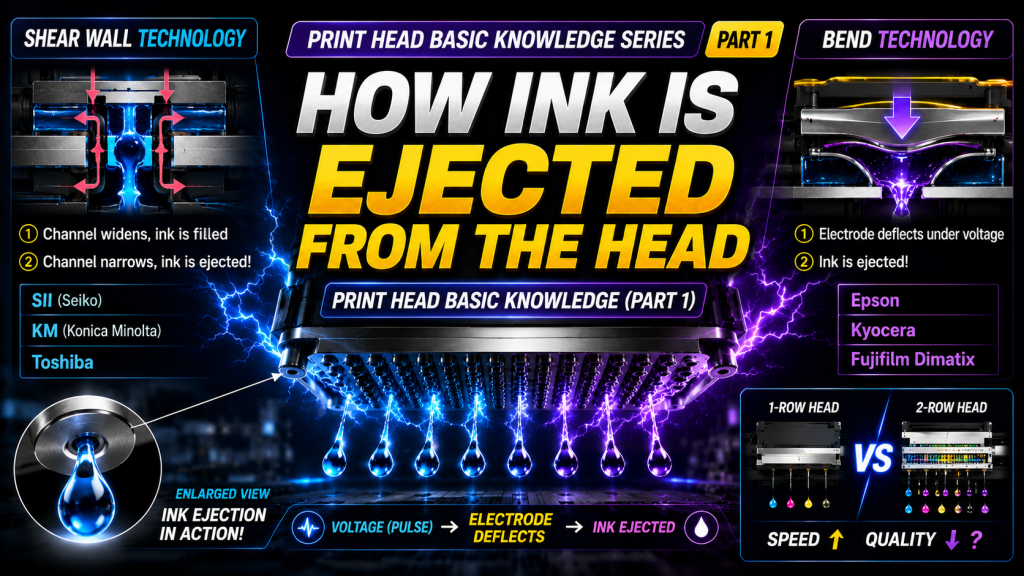
I. Two Methods of Ink Jetting from the Head — How Ink Is Jetted from the Print Head
1. Shear Wall Method
1_1. How Ink Is Jetted in the Shear Wall Method
- If you flip the print head over and look at the bottom, you can see long lines running across it.
- When you magnify those lines, they are composed of countless tiny holes, as shown on the right side of the diagram below.
-

How Ink Is Jetted from the Print Head - Inside those holes are narrow channels as shown in the diagram below, and these narrow channels repeatedly expand and contract.
- When the narrow channel expands, ink flows in from behind and fills the channel completely.
- When the channel contracts, the ink that was filling the channel is jetted outward in the opposite direction from which it entered.
- As the channel repeatedly expands and contracts, ink is jetted out of the head.
- This method of jetting ink by expanding and contracting the channel is primarily used in SII (Seiko), KM (Konica Minolta), and Toshiba heads.
- Head manufacturers call this method Shear Wall.
- For reference, in the field, the terms “head” and “nozzle” are often used interchangeably. To be precise, nozzles refer to the individual holes inside the head.
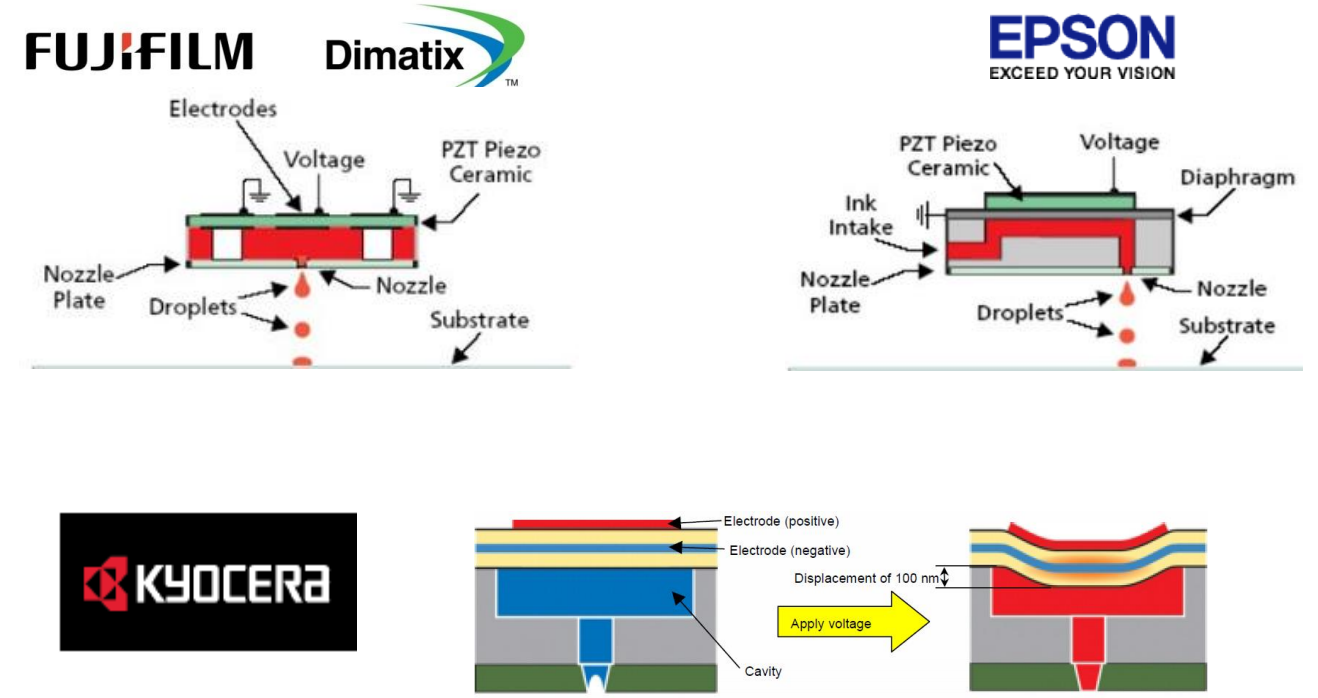
- In the diagram below, you can see how ink is jetted for each type of head. Ink fills the front of the nozzle, and when voltage is applied, the electrodes bend proportionally to the voltage, jetting the ink outward as they flex.
-

How Ink Is Jetted from the Print Head
2. Bend Method
- As shown in the diagram below, ink fills the channels inside the head, and when voltage is applied to the ink-filled channel, the electrodes bend proportionally to the voltage, jetting the ink outward as they flex.
- The basic operating principle is the same as Shear Wall.
- The method that uses both side walls to jet ink is called Shear Wall, while the method that bends a plate on top — rather than using the side walls — to jet ink is commonly called the Bend method.
- Primarily, Fujifilm Dimatix, Epson, and Kyocera heads use this method.
-
How Ink Is Jetted from the Print Head
II. Evaluating the Head You Use — How Ink Is Jetted from the Print Head
Here are some things worth knowing about print heads.
1. Wouldn’t Adding More Heads Increase Production Speed?
- When you first purchase a printer, production volume is not high, so the current printer works well enough. But as business grows and production volume increases, you start looking for a faster printer.
- At that point, the natural thought is: wouldn’t it be faster if we just add more heads?
- Of course, you could choose an expensive head with a large number of nozzles built in, but given the high cost and the risk of future replacement expenses, many users look for printers that mount more of the same budget heads they are already using, rather than switching to expensive ones.
- However, printers with heads mounted in 2-row or 3-row configurations for increased speed may suffer from lower print quality compared to a single-row arrangement.
- This was from my time working at an inkjet development manufacturer.
- To increase print speed, we once developed a 2-row × CMYK configuration as an upgrade from the 1-row × CMYK setup.
- No matter how much we tried to optimize print quality with 2-row CMYK, we could never match the quality of 1-row CMYK.
- The reason was that mechanically aligning the heads in a perfectly straight line was not easy, and even through software methods, matching the nozzle-spacing offset at the junction between two heads was also difficult.
- Additionally, within the head itself, the first nozzle and last nozzle did not jet in a perfectly straight line — there was a bowing phenomenon.
- We could not achieve the offset precision of 1-row CMYK with 2-row CMYK, and ultimately could not replicate 1-row CMYK print quality with a 2-row CMYK configuration.
- It was not a lack of technical capability. At the time, we were using Konica heads, and head engineers from Konica headquarters visited with expensive measurement equipment, but they could not solve the bowing issue between the first and last rows.
- In other words, even with a single head, ink jetting does not land 100% at the desired position. Adding another head on top of that makes it impossible to achieve single-head quality.
- It is good to know in advance that finding equipment that doubles speed by adding heads while maintaining the same quality is very difficult, and to keep this in mind when selecting a printer.
2. Is the Head Plate Made of Film or Ceramic?
- Some heads have a film-based bottom plate, while others have a ceramic bottom plate.
- If the head plate is made of film, scratches can damage the nozzles, and scratched nozzles may lose their jetting accuracy.
- Ceramic, on the other hand, resists most scratches without nozzle damage, but can crack under strong impact.
- For industrial heads, a ceramic bottom plate is preferable to film.

3. High-End Heads vs. Budget Heads
- If your workload is high, durable heads with more nozzles — meaning faster print speed — i.e., high-end heads, are the right choice.
- However, if your workload is not heavy, choosing a less durable, slower, and more affordable head is the better option.
- Many worry about buying budget heads due to lifespan concerns, but in reality, heads are more often replaced due to poor maintenance — the head striking the substrate during printing, UV curing causing clogs, or other accidents — than from natural wear.
- In any case, once a few nozzles start jetting at an angle or become clogged, print quality drops regardless of whether the head is high-end or budget, and the head must be replaced.
- At that point, considering replacement cost, choosing a budget head may be the wiser decision.
- That said, if you are an experienced user who manages heads well and is confident enough not to worry about potential accidents, a high-end head would be a good choice.
III. ARTJET UV Printer
After selling and maintaining ARTJET UV printers for over 5 years, we have learned one vital lesson.
The most important factor next to product stability is accumulating troubleshooting data.
Problems can occur with any equipment depending on the environment and user skill. What matters in the field isn’t “trouble-free equipment,” but:
How fast and how accurately you can find the cause and solve the problem when it occurs.
ARTJET continuously collects and organizes real-world problem data from the field to support faster and more accurate problem resolution.
🎥 View Print Quality Samples
🧾 Full List of UV Printable Products

* Note: Exterior design has been updated.
※ This article is based on actual field cases. Results may vary depending on the environment and equipment configuration.
핑백: Printhead Basics ARTJET 2025