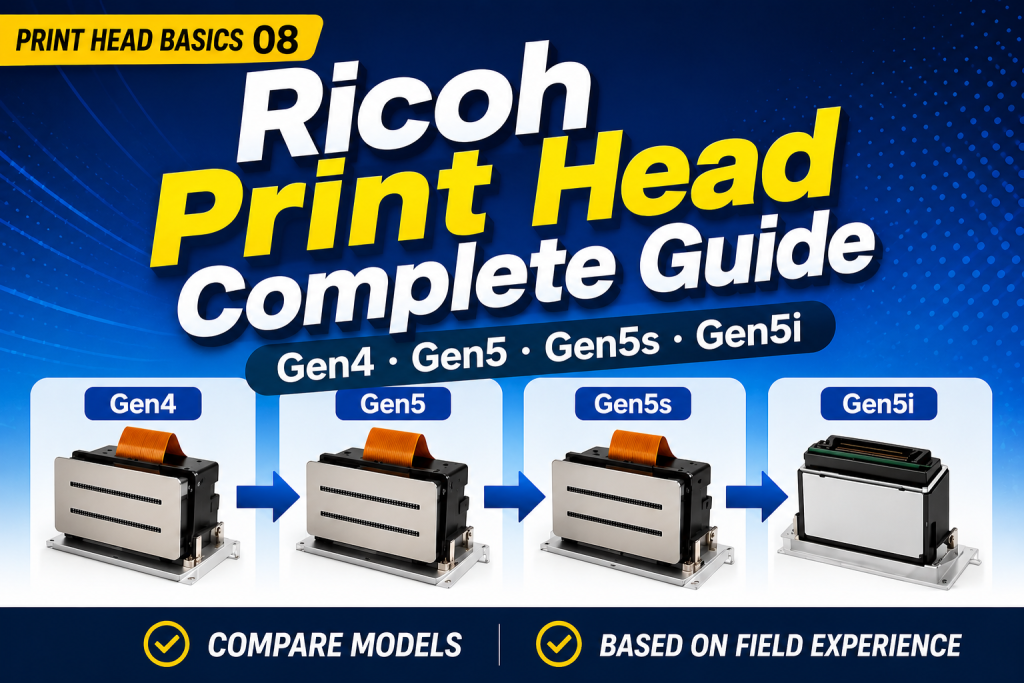
Ricoh Printhead Description — Printhead Basics (Part 8)
✅ Who Should Read This
- Anyone confused by the many Ricoh head variants
- Anyone curious about the differences between Gen4, Gen5, Gen5s, and Gen5i
- Anyone who wants to know which heads are most commonly used in compact UV printers
⚠️ Precautions
- This article is based on field visits and experience from 2019 — current market conditions may differ
- The term “Gen” does not appear on Ricoh’s official website — it is an industry nickname used in the field
- The spec table below focuses on large-format heads — compact UV heads such as GH2220 and TH5241 (Gen5i) are not included and should be verified separately
🧭 Key Summary (Field Insight)
- Ricoh heads support multiple colors in a single head — enabling lower-cost printer builds, but slower speeds than Konica heads
- Gen5s (2.5pl) offers the best print quality / Gen5i (TH5241, Xaar1201) was the most widely used head in UV printers
- Current market trend: speed-priority → Ricoh heads / price-priority → Epson heads
UV Printer Basics · Troubleshooting · Product Guides
We have organized our UV Printer content below. Click an item to read the full post.
1) Ink Supply
23 articles on ink supply issues, including cleaning and pumping
2) Print Head Issues
12 articles on head-related problems, from replacement methods to symptoms
For deeper printhead study: Printhead Basics — 9 Articles
3) Electronics / Software Issues
4) Mechanical Issues
5) Sai Flexi RIP Installation, Spot Color, Troubleshooting
6) UV Printable Products — Full Summary
📋 Printhead Basics — Full Series List
We are documenting printhead fundamentals in order. This list is updated with each new part.
08
Ricoh Print Head Overview
Ricoh Print Head Overview
Many printer users — and even service engineers — hold misconceptions about print heads, so we would like to explain the fundamentals of printhead knowledge.
Today, we summarize the Ricoh print heads most commonly used in the field.
I. How Head Trends Have Shifted — Ricoh Printhead Description
1. Before Epson Heads Were Sold Officially
1_1. Types of Chinese Printer Manufacturers
- Chinese printer manufacturers can broadly be divided into two types.
- Companies that develop their own electronic boards and software while manufacturing printers
- Companies that purchase boards and software from third parties and use them to manufacture printers
- Even manufacturers that develop their own boards and software cannot develop new versions for every new head release, so they sometimes purchase boards and software as well.
- As of 2019, the two most prominent board and software specialists in China were BYHX and Royal.
- BYHX had around 200 employees and was the largest board and software supplier in China.
- Royal was similarly a board and software supplier, with around 80 staff.
- Beyond these two, several other companies also supply boards and software.
- During visits to BYHX and Royal in October 2019, representatives told us: “Konica heads used to dominate, but Ricoh heads have been holding strong in the mid-to-low price segment.”
1_2. Ricoh Heads
- The key advantage of Ricoh heads is that multiple colors can be loaded into a single head, making it possible to achieve good print quality without complex mechanical alignment.
- Because two or even four colors can be loaded into one head, printers can be built at lower cost.
- However, the total nozzle jetting span is not particularly long, meaning Ricoh-based printers are slower than those using Konica heads.
1_3. Konica Heads
- Konica heads accept only one color per head, meaning good print quality cannot be achieved without precise mechanical alignment.
- Because each head carries only one color, the high-cost heads must be multiplied per color channel — making Konica-based printers inherently more expensive.
- However, the longer nozzle span makes Konica-based printers faster than Ricoh-based ones.
- Around 2019, Ricoh heads became the standard choice for mid-to-low-priced printers — particularly compact UV printers — due to their lower overall build cost.
2. After Epson Heads Began Selling Officially
2_1. Before Chinese Compact UV Printer Models Stabilized
- Compact UV printers were supplied exclusively by Japanese manufacturers — Mimaki, Roland, and Mutoh.
- Despite being compact machines, most used expensive industrial print heads, which kept equipment prices high.
- Sales were primarily concentrated in the US and Europe; in Asia, only large companies used Japanese products.
2_2. Before Chinese Compact UV Printers Stabilized
- Starting in 2015, Chinese manufacturers began pulling Epson heads from standard desktop office printers to build low-cost compact UV printers.
- But the early days were not smooth.
- These printers were made by small-scale operators rather than established manufacturers, so both the machines and the heads — sourced from consumer office printers — were unstable.
- Ink formulated specifically for Epson heads was also not widely available, leading to frequent ink-related problems.
2_3. As Chinese Compact UV Printers Stabilized
- By 2017, domestic Chinese sales of compact UV printers had exceeded 4,000 units.
- The small-scale operators had grown into proper manufacturers capable of producing stable machines.
- Seeing the rising sales volume, large UV printer manufacturers also began taking an interest in compact UV printer development.
- With 4,000 units sold, ink manufacturers began developing inks specifically formulated for Epson heads — and ink quality stabilized as well.
- The turning point came when Epson China officially agreed to supply Epson heads directly to Chinese printer manufacturers, which stabilized the head supply itself.
- Today, the trend is: Ricoh heads for speed-priority machines, Epson heads for machines where a slightly lower price point matters more than speed.
This article focuses on Ricoh heads — the choice for speed-priority machines.
II. Ricoh Print Head Quick Reference — Ricoh Printhead Description
1. Key Characteristics by Model
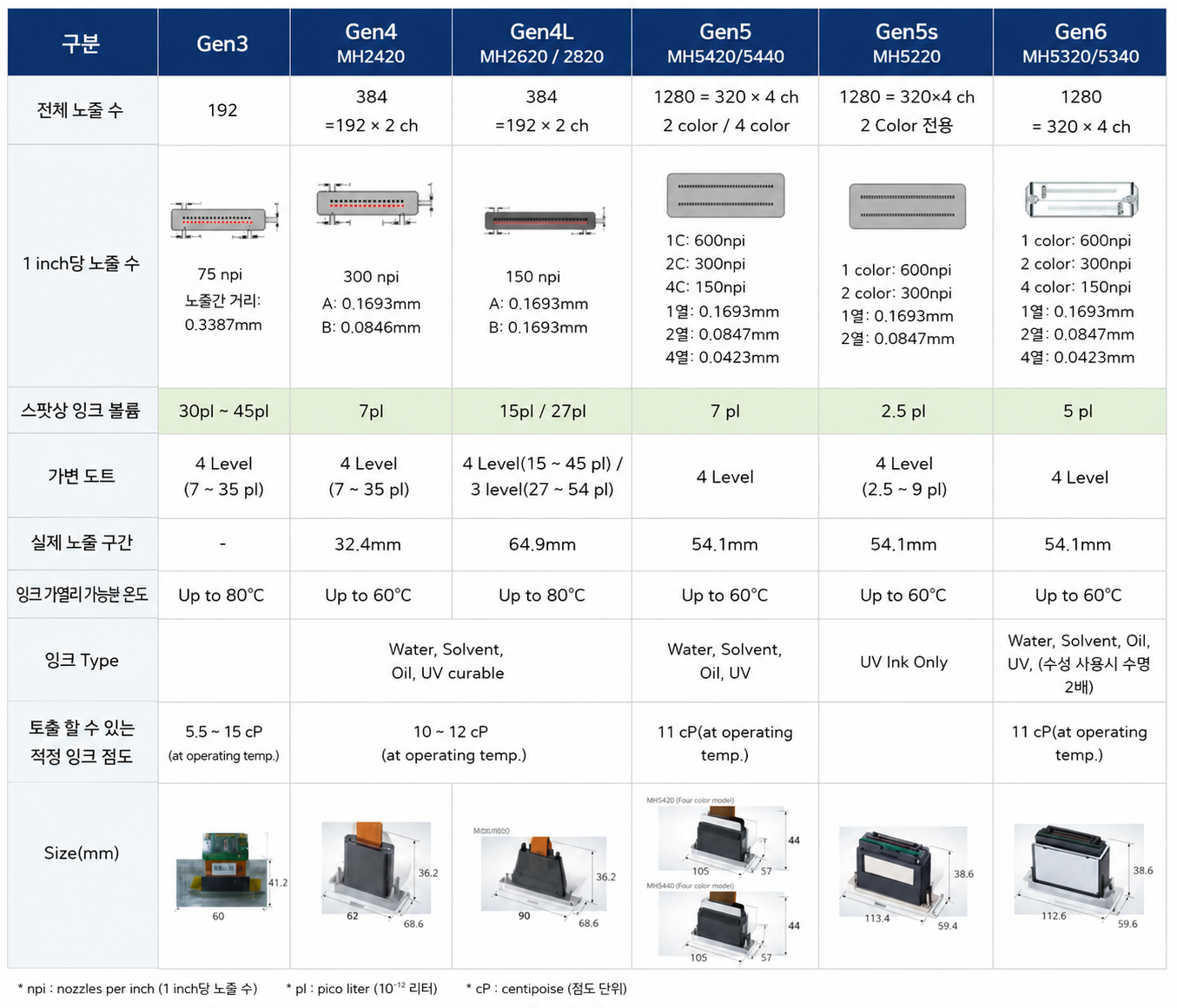
- Gen3 has 192 nozzles; Gen4 has 384 — essentially two Gen3 heads combined. They look similar and differ mainly in nozzle count.
- Starting with Gen5, the print span extends to 54.1 mm — significantly longer than Gen3 and Gen4’s 32.4 mm — with a total of 320 × 4ch = 1,280 nozzles.
1_2. There are many variants, but grasping the key characteristics below makes Ricoh heads much easier to understand.
- Gen4: 7pl, 384 nozzles. Not widely used today.
- Gen5: 7pl, 1,280 nozzles. Speed varies depending on how many channels are dedicated to each color, but running all 1,280 nozzles on a single color makes it 2–3× faster than Gen4.
- Gen5s: 2.5pl, 1,280 nozzles. Dramatically better print quality than earlier heads thanks to the smaller drop volume.
- Gen6: 5pl. Ricoh’s documentation notes double the lifespan when used with water-based ink — suggesting it was designed with aqueous ink as the primary target.
1_3. Other Heads
- TH5241: 3pl, 27.1 mm nozzle span, supports up to 4 colors. Known as the Gen5i and Xaar1201, this was one of the most widely used heads in UV printers over the past several years.
- GH2220: 3–5pl, designed for water-based and solvent inks. UV ink is not listed in the spec sheet, but Korean manufacturer Apache has used it in compact UV printers.
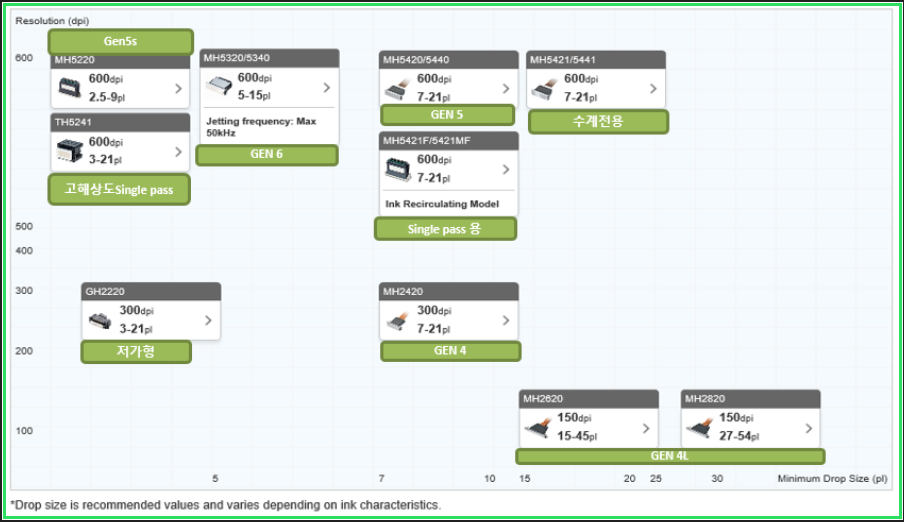
- MH5421: A recirculating head designed exclusively for high-end single-pass machines.
- Note: the term “Gen” does not appear on Ricoh’s official website. The photo below shows the official Ricoh printhead model names.
-
Ricoh Printhead Description
2. Ricoh Print Head Spec Summary
- The table below focuses on heads used in large-format inkjet equipment. GH2220 and TH5241 (Gen5i), which are primarily used in compact UV printers, are not included — please verify those separately.
- For detailed information on the Gen5i (TH5241, Xaar1201) — the most widely used head in UV printers — refer to the link below.
- Why You Need to Understand Print Head Spec Values
-
Ricoh Printhead Description
III. ARTJET UV Printer
After selling and maintaining ARTJET UV printers for over 5 years, we have learned one vital lesson.
The most important factor next to product stability is accumulating troubleshooting data.
Problems can occur with any equipment depending on the environment, working conditions, and user skill level. What matters in the field is not “trouble-free equipment,” but:
How fast and how accurately you can find the cause and solve the problem when it occurs.
ARTJET continuously collects and organizes real-world problem data from the field to support faster and more accurate problem resolution.
🎥 View Print Quality Samples
🧾 Full List of UV Printable Products

* Note: Exterior design has been updated.
※ This article is based on actual field cases. Results may vary depending on the environment and equipment configuration.