UV Printer History and Future Part 5 of 5
So far, I have summarized the information related to UV Printers below. If you click on the article, you will be taken to the link for related information.
24 articles on ink supply issues,
9 articles on head basics,
12 articles on actual head issues and their solutions,
10 actual mechanical Machine Problems and Solutions.
12 Problems and Solutions of Electronic Boards and SW Actually Issued
11 Problems and Solutions: Sai Rip Installation and Basic Settings, Spot Color Creation, and More
We’ve compiled a list of products that can be made with a UV printer.
I. Last time _UV Printer History and Future Part 5 of 5
So far, we have looked at the following:
-
- Part 1: Changes in UV Printer Product Line “Conveyor Belt Type => Flatbed Only => Roll Only => Mercury to LED Conversion”.
- Part 2: The emergence and disappearance of major players in the UV Printer field “we looked at the past and present of UV printer manufacturers excluding China.
- In Part 3, we looked at “China’s Process of Entering Overseas Markets”, which produces 80% of UV Printers.
- Part 4. Since more than 80% of UV printers in the world are produced in China, we will be able to predict the history of UV printers and their future by looking at the “Current Situation of Chinese Manufacturers and Their Strategies.” In Part 4, we explained the “Current Situation of Chinese Manufacturers.”
Today, we will look at the “Product Strategy” of a Chinese company leading the inkjet market and draw a conclusion about “UV Printer History and Future”.
II. Chinese Manufacturer Product Strategy _UV Printer History and Future Part 5 of 5
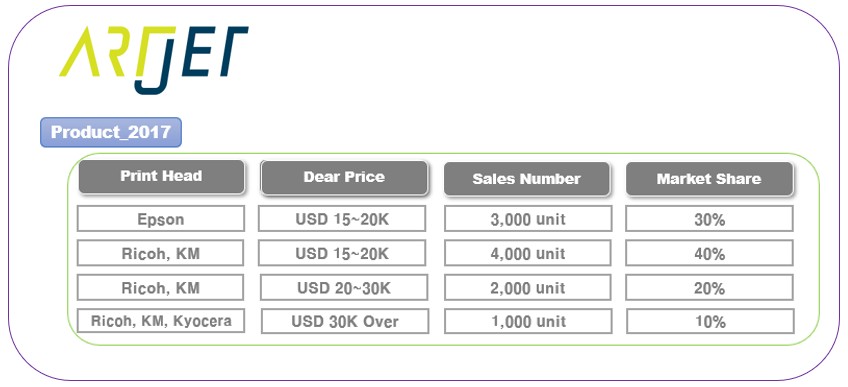
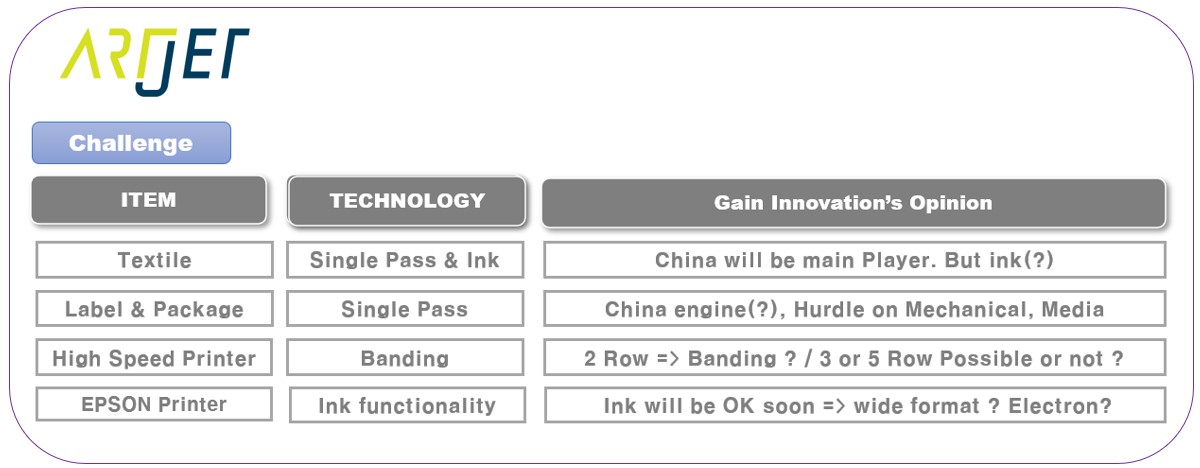
Chinese manufacturers are moving into four markets: textiles, label packaging, and the low-end market, which uses high-speed printers or Epson heads.
1. Textile Printer _ UV Printer History and Future Part 5 of 5
In 2016, when I was working at InkTec, I had an OEM discussion with Roland for a UV printer.
A Roland OEM representative suggested a meeting at ITMA, a Chinese textile exhibition, so I went there.
I had only seen solvent printer and UV printer exhibitions, and this was my first time at a textile exhibition.
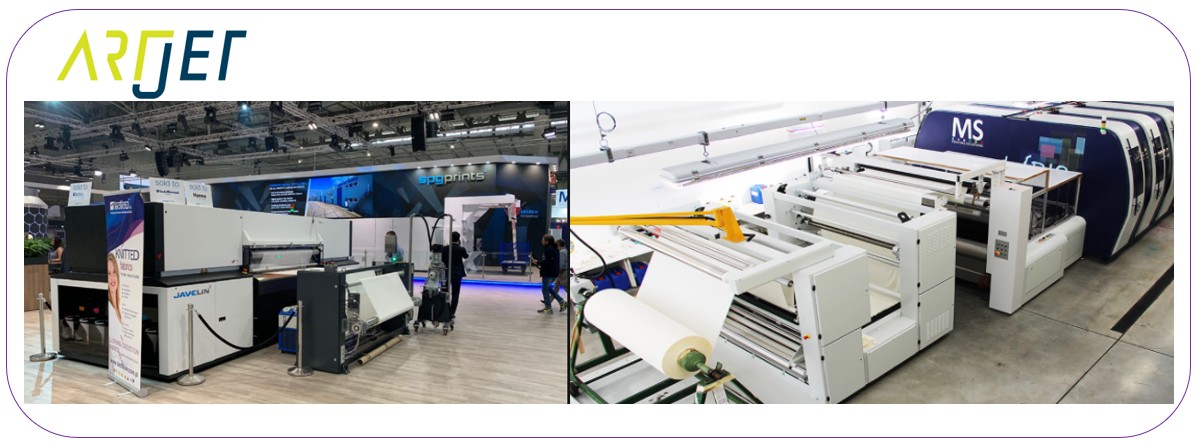
There were more companies that showcased textile printers than I thought, and all of the companies that showed up at the exhibition were companies I had never heard of before.
At that time, I thought that UV printer manufacturers were the mainstay of inkjet, so seeing all those textile printer manufacturers made me realize that UV printer field was narrow.
One more surprising thing was that, unlike UV printer manufacturers, all of those companies were very large in scale.
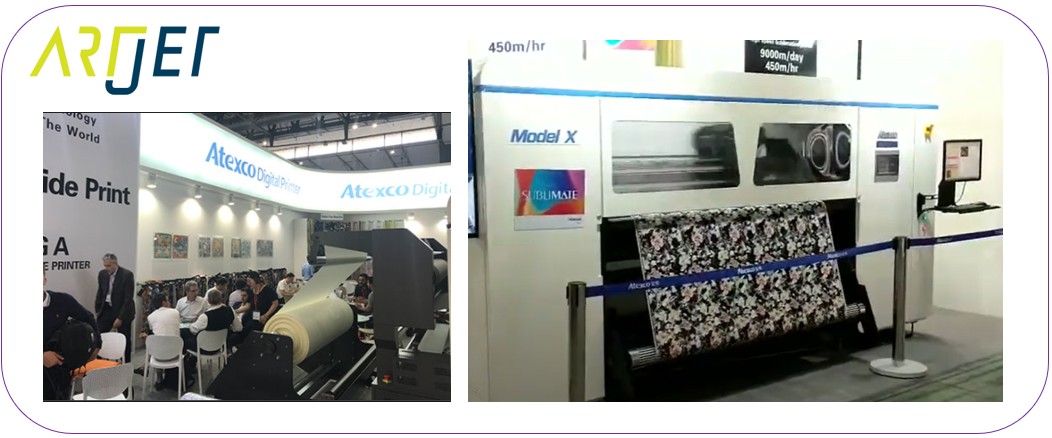
Among them, I saw Chinese players. A company called ATEXCO had a large booth with many people, and the design and performance of the equipment itself were so good that I didn’t think it was made in China.
Techwin is a company that has been trying to enter the global market with UV printers since 2005, and they were introducing single pass equipment. Of course, the level of completion at that time was not good.
And, the HandTop salesperson I mentioned earlier said that they had already started the textile business and that the model would be released soon.
The person in charge who was close to me has now become a director, and said, “Leave the UV business division to someone else and focus on the new business division, textiles.”
In this way, several manufacturers have chosen a product strategy targeting the textile market.
2. Label & Package Printer _UV Printer History and Future Part 5 of 5
When I was working at InkTec Co., Ltd., I was in charge of the Label Printer new business division and focused on everything from business feasibility review to product concept and sales for 2-3 years. Naturally, I went to overseas exhibitions, and if I quote the report from that time,
Report on the China Print Exhibition in May 2017,
- Chinese company JHF is rapidly growing in the signage industry, and its participation in the label exhibition suggests it is considering the production of label printers in the future.
- Flexo and printing equipment manufacturers were selling digital label printers. Traditional Chinese printing equipment manufacturers are also expected to develop and manufacture inkjet label printers.
- China’s Amica (JimChang, the first company in China to provide board software) also exhibited a single-pass label printer engine.
- With board and software developers providing inkjet engines, it’s expected that Chinese flexo companies will go digital, or UV printer manufacturers will enter the label and packaging markets.
September 2017 Brussels Label Expo
- Here’s a quote from a conversation I had with the sales director of a large Chinese printer manufacturer:
“The sign market is fiercely competitive, margins are low, and I came to see what they were going to do. As I kept looking around, I saw a lot of Chinese manufacturers! They were all the same. What should we do now? We’re wondering. We’re going to try our hand at label printing, too.” - At the time, I was manufacturing label printers, so I told the Chinese sales director (who I briefly worked with as a partner in 2004, so we’re on good terms with each other):
- “When I tried single-pass printing, it wasn’t easy. I think there’s a difference in the difficulty between scanning and single-pass printing. Mechanical precision is also very important.”
- The Chinese friend said, “What could be difficult? If you just install an inkjet engine on an existing flexo printer, it should be finished in about a year.”
In 2017, China was also interested in label packaging and moving forward.
The difficulty of making the product complete is high, but since it started in 2017, it is expected that the completeness will gradually increase and the day will come when it will be sold on the market.
3. High-speed UV printer _UV Printer History and Future Part 5 of 5
I can’t help but mention SwissQ Swiss UV Printer.
It is the only printer that implements the best quality through the KM1024 head 2-row arrangement among UV flatbed printers.
Chinese manufacturers were also trying 2-row, 3-row, and even 5-row arrangements for Flora.
Since Konica heads don’t work, they are trying Kyocera heads that have twice the number of nozzles and length of Konica heads, and also Kyocera head 2-row arrangement.
However, it is not easy to implement the print quality of 1-row arrangement through 2-row arrangement, and I know that many manufacturers are struggling because of this.
At InkTec, where I worked before, I thought the KM1024 2-row arrangement would be easy, so our engineer debugged for 4 years, and eventually they were able to change the head and the entire model and improve the quality to some extent.
Since they manufactured UV printers, the easiest and fastest approach was to release equipment that increased productivity, so all Chinese UV printer manufacturers promoted product upgrades like this.
Another product strategy is to create highly productive equipment in the existing UV Printer market.
4. UV Printer with Epson Head _UV Printer History and Future Part 5 of 5
The old small flatbed UV printer also used industrial heads such as Ricoh.
The biggest reason why industrial heads had to be used was that Epson heads had to use low-viscosity ink, and due to the nature of UV ink, it was not easy to achieve functionality (adhesion) at low viscosity.
However, that was short-lived, as low-viscosity UV ink entered the market (of course, there were many defects at first. It gradually improved), and suddenly many small printers began to come out with Epson heads.
In 2019, Epson China announced “Official Supply of Epson Heads to Printer Manufacturers,” and
Since then, most small UV printers have been equipped with Epson print heads.
Small UV printers, or low-cost UV printers, are not made by main Chinese manufacturers, but are mostly made by new companies. However, this is also a trend, so it is stated like this.
III. 2025 situation _UV Printer History and Future Part 5 of 5
1. 2025 Update _UV Printer History and Future Part 5 of 5
1. Textiles
Companies that have set their product strategy on textiles have seen tremendous growth.
According to Nicky, a supplier of ARTJET UV Printers, they have grown four times since 5 years ago, and the biggest factor is Textile Printers.
2. Label Packaging
With technology that has been around for over 100 years, the standards for quality and speed for users of equipment that produces final products are high.
Durst launched its first model in 2009, and since 2017, label printer sales have increased (Durst itself is almost at the top in terms of inkjet technology),
so even a company with good technology has created a model that can be sold in 8 years.
Chinese manufacturers started in 2017, and launched their first model 2-3 years later, but Chinese label printers have not been installed in Korea until 7 years later,
so companies that have set product strategies with label printers will have failed strategies until 2025.
3, 5-row UV printer
Every Chinese manufacturer is trying it, but it seems that few companies have improved the level of completion.
This is also being made by all competitors, so the margin is still not good, so most major manufacturers are not focusing on it.
This strategy is also expected to fail, as the technical difficulty is too great to become mainstream and the sales margins are not large.
4. UV printers equipped with Epson heads
Until now, only small models have been equipped with Epson heads, and large models equipped with Epson heads have not been released yet.
Epson print heads are actively used only in small models.
2. Conclusion _UV Printer History and Future Part 5 of 5
Ultimately, future UV printer models will likely change slightly, but I don’t expect any groundbreaking new models to emerge.
Applying the current situation to Korea,
- Large-size UV printers are saturated and sales are unlikely to continue.
- Medium-size 600 x 900 printers are widely available, but we still see occasional demand.
- We anticipate A3 and A4-size UV printers will become more popular, especially among startups.
- While it’s questionable whether these sizes and productivity will be profitable, I think they’re a good side hustle.
- Textile manufacturing has developed only in certain countries, so it’s questionable whether textile printer sales will flourish in Korea. However, small, customized DTF printers are likely to become mainstream in the market.
- Korean consumers have high standards for label quality, so I don’t expect Chinese label printers to be readily available.
As the saying goes, when Chinese products become mainstream, the market is over. From an equipment sales perspective, the UV printer market is saturated, and it’s unclear how long this will last.
However, those who are using UV printers believe that the market will continue for a long time because they can create various applications with UV printers.
V. This is how ARTJET supports our customers.
One thing I feel while selling and maintaining ARTJET UV Printers for 5 years is that the next most important thing after product stability is Troubleshooting DATA.
All products have problems, whether they are actual equipment problems or consumer errors, and product stability is how easily and quickly you solve those problems.
We are organizing all the troubleshooting DATA as follows.
You can see the product print quality by clicking here.

1. Additional information on printhead problems
Please refer to the information summarized above, and the additional information summarized below is as follows.
Addition
“After connecting the DATA Cable, one channel is not fired”
2. Additional information on ink supply issues
Please refer to the information summarized above, and the additional information summarized below is as follows.
Addition
“no clogged nozzles, but banding in the red ARTJET 2025”
“When I print it, the whole thing has a yellow tint to it”
3. Additional problems due to equipment problems or management negligence
Please refer to the information summarized above, and the additional information summarized below is as follows.
“I see a white line after 600mm on the Y-axis.”
4. Additional information on Electron board and Software issues
Please refer to the information summarized above, and there is no additional information summarized yet.
5. Additional information on Sai Flexi Rip software
Please refer to the information summarized above, and there is no additional information summarized yet.
6. Problems and solutions from actual consumer sites
1. Paper that absorbs ink
2. A line-like thing appears at the end of the white print surface
3.Can varnish banding be reduced?
4. Are there many problems with China’s UV Printer?
7. UV Printer Application
Please refer to the information summarized above, and there is no additional information summarized yet.
8. Bonus
1. UV Printer Old Model Refurbished _updated
2. UV Printer Laser Cutter Bonding Machine Which equipment should I buy first? _updated
3. Considerations when choosing a UV printer _updated
4. DTF Printer Price and Specification Survey_updated
5. Acrylic Bonding Equipment Don’t Put It Off Anymore
6. China inkjet level now_updated
7. Thoughts on KOSIGN 2024_updated
8. ARTJET Delivery Preparation
9. ARTJET Setting Sequence
10. UV Printer History and Future Prediction 1_updated
11. UV Printer History and Future Prediction 2_updated
12. UV Printer History and Future Prediction 3_updated
13. UV Printer History and Future Prediction 4 _updated
14. UV Printer History and Future Prediction 5
15. Are there many problems with China’s UV Printer?
16. UV Printer Small Text Meaning
17. Is the XP600 head okay
18. Roland UV Printer Summary
19. Mimaki UV Printer Summary
20. UV Printer Alibaba Direct Purchase Considerations
21. Things to consider when buying a used UV Printer
22. Bi Uni Print Quality Differences
23. RDworks download install and laser head position by SW
That’s it for today.