- Anyone researching DTF printer prices and specs before buying
- Anyone trying to tell a manufacturer apart from a distributor when sourcing equipment from China
- Anyone considering a group buy for DTF equipment
- Anyone wondering whether an XP600, i3200, or i1600 head is the better choice
- A lower price isn’t necessarily a better deal — check whether the seller is a manufacturer or just a distributor
- In this research, XP600 heads weren’t compatible with DTF white ink, and the ink lines inside the head burst after about two months of use
- The same equipment can show up cheaper on Alibaba than through some resellers — always cross-check pricing
- A cheaper group-buy price can come at the cost of after-sales support and accountability
- Company D and Company T were both manufacturers with nearly identical pricing; Company O turned out to be mainly a consumables distributor and was excluded despite a lower price
- The i1600 head has become more common than the i3200, while XP600 was ruled out due to compatibility issues with DTF white ink
- The group buy fell through because buyers prioritized price, while the supplier prioritized trustworthiness, support, print quality, and ICC profile capability
- When sourcing equipment from China, distinguishing a manufacturer from a distributor is one of the most important factors for reliable after-sales service
I. Price and Specifications _ DTF Printer Price and Specification Research
Print heads:
- Initially, most printers used the XP600 or i3200 heads.
- Now, the i1600 print head seems to be the most commonly used.
- The XP600 heads we initially used weren’t compatible with DTF white ink, and the ink lines inside the head burst after about two months of use.
- For this reason, we now primarily use the i3200 or i1600 heads.
Equipment prices:
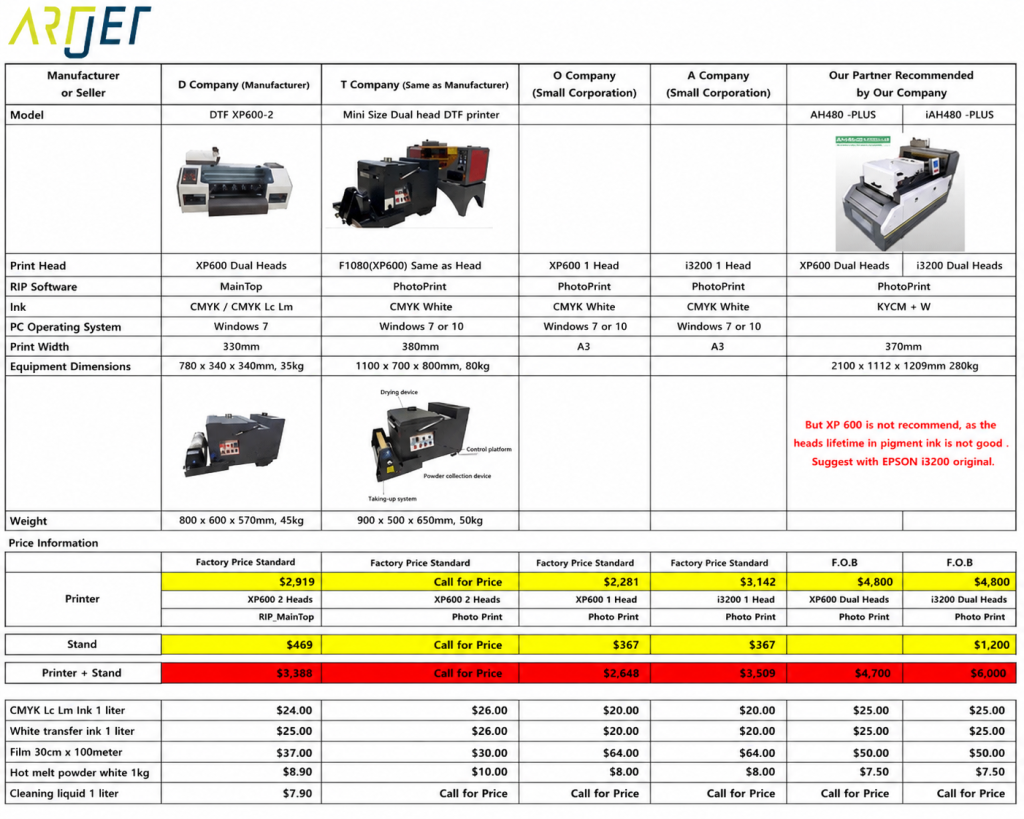
- A unit with two XP600 heads costs approximately $3,400.
- A unit with two i3200 heads costs approximately $4,800.
- Shakers range from inexpensive units around $400 to pricier ones around $1,200.
Ink prices run approximately $20–$25, hot-melt powder is $7–$10, and most packages also come with film.

In the pricing table above, Company D and Company T:
- Both companies appeared to be manufacturers, and their prices were nearly identical.
- Company D provided all the requested information in one table and seemed to have extensive experience handling these inquiries.
- Company T only quoted a price on the condition of buying three units at once, and we didn’t understand why they were pushing a three-unit minimum without any internal verification.
Company O sent us information via email through a third party.
- Many of the product photos in the email were broken links, so we searched for the company on Alibaba just in case.
- Most of their listed products were consumables rather than equipment — they looked more like a consumables distributor than an equipment manufacturer.
- If a company that specializes in consumables also sells equipment, getting after-sales support can be difficult if something goes wrong.
- For that reason, we excluded Company O even though its price was cheaper.
The last quote we got, through a partner we already knew, was:
- higher than the other companies for the equipment itself,
- but when we found the same model listed on Alibaba, that price was actually lower than what Alibaba showed.
II. Why We Abandoned a Group Purchase of DTF Printers _ DTF Printer Price and Specification Research
Our CEO, who uses our UV printers, asked about a group purchase, so we researched several DTF printer suppliers.
Rather than simply copying and pasting Alibaba listings, we organized the data by exchanging emails directly with each supplier’s contact person.
For this first group purchase, we didn’t factor in profit beyond a few percent in commission — we opened up all pricing. Since pricing was fully transparent, we planned to add a reasonable margin and run group buys again whenever there was demand, even if that meant reselling supplies.
People looking to buy equipment through the group purchase prioritized price above everything else.
As the equipment supplier responsible for after-sales service, our priorities looked different:
- Is the company trustworthy?
- Since a proper product manual is rarely available, will staff actually be reachable to answer questions during installation, or proactively support us if problems come up?
- Will staff be responsible and responsive if something goes wrong?
- Will print quality be good enough?
- Can the RIP capture ICC profiles, meaning real color adjustment is possible?
- Is after-sales service easy to access if the printer has issues?
Does the equipment work properly? Is the quality acceptable? Is support easy to reach? Is after-sales service convenient? These were our priorities.
Even if the equipment cost more, as the supplier we prioritized safe, dependable after-sales support above all else.
But there was a real gap in perspective.
Looking back at the data we shared above,
- you can get a sense of overall pricing,
- which helps you spot whether a seller is overpricing their equipment.
- There’s also a clear reason not to pick the XP600 head just because it’s cheaper,
- and you can see that the i1600 head has become more popular than the i3200.
Just checking this information alone should be a big help if you’re thinking about buying the equipment yourself.
IV. ARTJET UV Printer
