UV Printer History and Future Part 3 of 5
So far, I have summarized the information related to UV Printers below. If you click on the article, you will be taken to the link for related information.
24 articles on ink supply issues,
9 articles on head basics,
12 articles on actual head issues and their solutions,
10 actual mechanical Machine Problems and Solutions.
12 Problems and Solutions of Electronic Boards and SW Actually Issued
11 Problems and Solutions: Sai Rip Installation and Basic Settings, Spot Color Creation, and More
We’ve compiled a list of products that can be made with a UV printer.
In the first hour, we looked at the product line flow.
Simply put, the UV printer model has changed: “Conveyor belt type => Flatbed only => Roll only => Mercury to LED.”

In the second session, we examined the past and present of UV printer manufacturers excluding China to understand the evolution of UV printers and predict their future.
We looked at companies that have transitioned from signage to label packaging, and those that have partnered with Chinese companies to continue their UV printer business.
In conclusion, we concluded that approximately 80% of UV printers worldwide are manufactured in China.

In this third installment of our series on the history and future of UV printers,
we’ll delve into the trends of Chinese manufacturers, their current situation, and their efforts to overcome this situation.
We’ll further explore our goal of understanding the history and future of UV printers.
First, let’s examine how Chinese manufacturers have played in the UV printer market.

I. Chinese manufacturers’ early entry into overseas markets(2005~2009) _ UV Printer History and Future Part 3 of 5
I don’t think I saw any Chinese UV printers at the 2004 SGIA exhibition in the US.
However, the very next year, in 2005, Chinese manufacturers also showcased UV printers at international exhibitions.
I remember Flora, Techwin, and three others.
For the next three or four years, Chinese manufacturers participated in almost every exhibition, and with their low prices, they quickly established numerous dealers in various countries, especially in Europe.
In the early stages of their overseas expansion, Chinese UV printers seemed to be dominating the global market.
II. 3 years later(2010 ~2015) _UV Printer History and Future Part 3 of 5
1. In overseas markets_UV Printer History and Future Part 3 of 5
Unlike the initial atmosphere in 2005, two or three years later, in 2007 and 2008, Chinese UV printers began to receive harsh criticism.
Let me tell you a story.
A friend of mine became our UV printer dealer, and in 2005, he was the Dutch dealer for the Flora UV Printer.
With a low price, he installed six Flora UV Printers right away.
After installing the first unit without any problems, he looked at the soldering tools in the tool box,
and laughed with the customer, saying, “Why did you send me the soldering iron? Surely I don’t need to solder? You’re just joking.”
A month later, when he contacted China about a data problem during printing,
they said, “Just fix the board with the soldering iron in the tool box.”
He laughed and said this over drinks, but at the time, there was no other way to handle it, so he even considered emigrating to Australia.
Initially, a few dealers displayed Chinese UV printers in their showrooms.
Soon, however, a widespread perception emerged in the European and North American markets that Chinese UV printers were unsafe and should not be sold.
Also, at this time, models that weren’t Chinese but were playing a role in the market at low prices emerged.
- Colorspan’s UV printers were also available at low prices,
- and the OCE UV printer, which offered good print quality, was also reasonably priced.
- And Agfa’s Dilli OEM model was also reasonably priced.
As the price merits of Chinese products declined, their reliability became increasingly apparent, and after 2010, Chinese UV printers were nowhere to be found at overseas exhibitions.
At this time, everyone was concerned that Chinese UV printers might be completely driven out of the market.
2. But in the Chinese domestic market _UV Printer History and Future Part 3 of 5
Since our company has a Chinese UV printer dealer, I naturally attended or participated in Chinese exhibitions several times a year.
While visiting each year, I witnessed the steady growth of Chinese UV printer manufacturers, but the print quality wasn’t as good as I’d hoped.
Banding was severe, and white ink would fly around the printer, scattering around the printer.
But that didn’t last long.
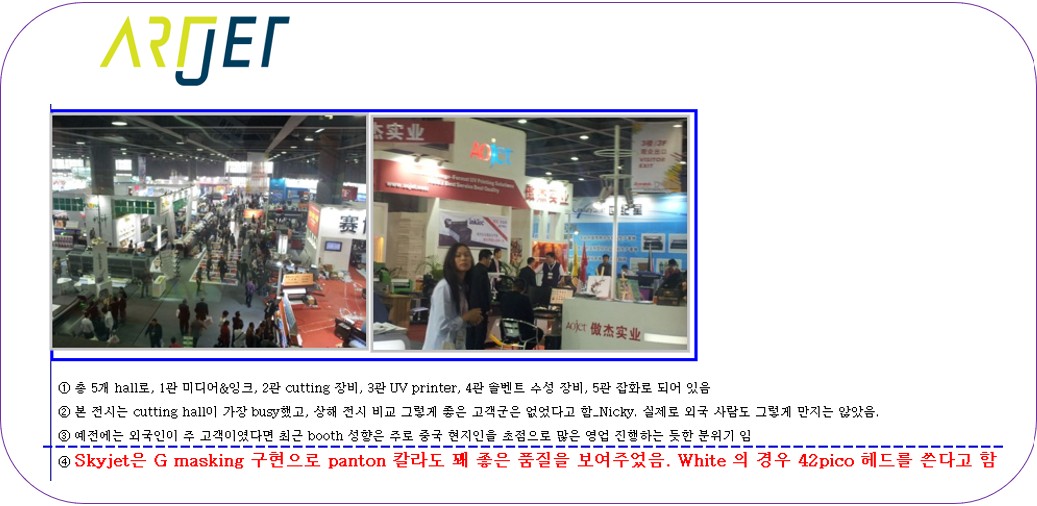
At the 2013 Guangzhou exhibition, I saw a Chinese manufacturer’s UV printer that used G-mask (known in China as Feathering Mask) to print single-color prints without banding.
G-mask was a groundbreaking software technique that reduced print banding, and only the most technologically advanced manufacturers were able to implement it.
The JETRIX UV printer from the Korean manufacturer InkTec had finally achieved this after three to four years of research, but the Chinese UV printer was demonstrating it at the exhibition.
The red text in the report below signifies that “Chinese UV printers will now dominate the global market,” and I realized this in 2013.
III. Time for technology development_UV Printer History and Future Part 3 of 5
1. The meaning of G mask_UV Printer History and Future Part 3 of 5
When printing a single color (which is barely visible on a normal image), the print isn’t as smooth as silkscreen printing. Instead, streaks appear at the ends of the print head’s path.
This streaking is called “banding.”
Solvent printers, when the ink runs out, spread it and the heat adheres to the material, blurring details. This banding isn’t visible.
However, UV printers harden the ink immediately after it runs out, so the areas where the ink has passed are particularly noticeable.
UV printer dealers and users alike evaluate print quality based on the severity of this banding.
To mitigate this banding, a “G mask” (feathering mask) is used to create a complex nozzle spray pattern, like rain. This method significantly reduces banding.
2. This means that the Chinese manufacturer made the G mask._UV Printer History and Future Part 3 of 5
This was when Inktec was selling the JETRIX UV Printer.
For two years, starting in 2009, after each overseas sign exhibition, my SW engineers and I would rummage through the trash to bring back any damaged or tested prints from OCE and SwissQ.
They use the same Konica Minolta print head, but SwissQ UV printers don’t have banding. Although they use different heads, OCE UV printers don’t either.
While you can’t see it in the finished print, damaged prints stop mid-print.
You can see the dots between intermediate passes and passes, and these dots can be used to predict the ink spraying logic. So, after each exhibition, we’d rummage through the trash.
For two years, our SW engineers and I had painstakingly developed the G-mask. As the third company in the world to implement the G-mask, we expected significant sales.
However, in less than two years, we had also implemented a Chinese product, and the only difference between our products and the Chinese ones, the SW technology, was now on par.
That was also in 2013.
The implementation of the G mask meant that Chinese UV printers were no longer significantly different from those from Korea, the US, Europe, and Japan.
Given the nature of the Chinese market,
I thought that if one manufacturer implemented the G mask, all Chinese manufacturers would soon follow suit, and it would soon re-emerge in overseas markets.
IV. Chinese UV printers reappear at overseas exhibitions (since 2015)_UV Printer History and Future Part 3 of 5
1. A company with experience in advancing into the market _UV Printer History and Future Part 3 of 5
In 2015, the UV printer exhibitors were primarily companies that had previously failed in overseas markets.
Although they had previously failed in overseas markets, the company had grown significantly for the following reasons:
- Although not under their own brand, they were supplying UV printers to major US and European companies as OEMs,
- and maintained high sales in the substantial Chinese domestic market.
- They also maintained high sales in China, South America, and Eastern Europe, where solvent printers, in addition to UV printers, were still popular.
When I spoke with a Chinese representative at the exhibition,
they had several successful meetings, but rumors that they were supplying to other markets as OEMs made it difficult to find dealers.
However, two years later, they had established dealerships in several countries.
Because of the nature of Chinese manufacturers, even a slight exterior change could result in a different model, and they supplied their products to dealers in each country to avoid overlapping with OEMs.
2. A company I’ve never heard of before _UV Printer History and Future Part 3 of 5
In 2015, the exhibitors were mainly large companies, but in 2017, FESPA featured a variety of Chinese companies, including some I’d never heard of before.
Some companies even had European customer service offices, while others hired local European customer service representatives.
When I spoke with Chinese salespeople before, they lacked much knowledge of UV printers and their English wasn’t fluent.
But at the 2017 exhibition, they had accumulated experience and knowledge selling UV printers in China, and they spoke fluently.
Just as the quality of UV printers improved, so did the mindset and qualifications of the salespeople.
For example, there was a Chinese company called Handtop. Every time they exhibited, we had a booth next to mine, so I became close with the salesperson in charge.
When we first met, the booth was small and shabby. But when we spoke exactly three years later,
- they had sold 290 printers this year, and that was in 2016.
- They started with 10 people, but now have around 100.
- As production has grown, they’re concerned about how to manage quality control.
This new company has also been growing.
We’ve looked at the trends in Chinese manufacturers so far.
Next time, we’ll explore how Chinese manufacturers were able to develop and produce UV printers so quickly.
If you’d like a preview, please refer to the YouTube video below.
V. This is how ARTJET supports our customers.
One thing I feel while selling and maintaining ARTJET UV Printers for 5 years is that the next most important thing after product stability is Troubleshooting DATA.
All products have problems, whether they are actual equipment problems or consumer errors, and product stability is how easily and quickly you solve those problems.
We are organizing all the troubleshooting DATA as follows.
You can see the product print quality by clicking here.

1. Additional information on printhead problems
Please refer to the information summarized above, and the additional information summarized below is as follows.
Addition
“After connecting the DATA Cable, one channel is not fired”
2. Additional information on ink supply issues
Please refer to the information summarized above, and the additional information summarized below is as follows.
Addition
“no clogged nozzles, but banding in the red ARTJET 2025”
“When I print it, the whole thing has a yellow tint to it”
3. Additional problems due to equipment problems or management negligence
Please refer to the information summarized above, and the additional information summarized below is as follows.
“I see a white line after 600mm on the Y-axis.”
4. Additional information on Electron board and Software issues
Please refer to the information summarized above, and there is no additional information summarized yet.
5. Additional information on Sai Flexi Rip software
Please refer to the information summarized above, and there is no additional information summarized yet.
6. Problems and solutions from actual consumer sites
1. Paper that absorbs ink
2. A line-like thing appears at the end of the white print surface
3.Can varnish banding be reduced?
4. Are there many problems with China’s UV Printer?
7. UV Printer Application
Please refer to the information summarized above, and there is no additional information summarized yet.
8. Bonus
1. UV Printer Old Model Refurbished _updated
2. UV Printer Laser Cutter Bonding Machine Which equipment should I buy first? _updated
3. Considerations when choosing a UV printer _updated
4. DTF Printer Price and Specification Survey_updated
5. Acrylic Bonding Equipment Don’t Put It Off Anymore
6. China inkjet level now_updated
7. Thoughts on KOSIGN 2024_updated
8. ARTJET Delivery Preparation
9. ARTJET Setting Sequence
10. UV Printer History and Future Prediction 1
11. UV Printer History and Future Prediction 2
12. UV Printer History and Future Prediction 3
13. UV Printer History and Future Prediction 4
14. UV Printer History and Future Prediction 5
15. Are there many problems with China’s UV Printer?
16. UV Printer Small Text Meaning
17. Is the XP600 head okay
18. Roland UV Printer Summary
19. Mimaki UV Printer Summary
20. UV Printer Alibaba Direct Purchase Considerations
21. Things to consider when buying a used UV Printer
22. Bi Uni Print Quality Differences
23. RDworks download install and laser head position by SW
That’s it for today.