Primer Functionality and Concerns — UV Printer Products (Part 9)
✅ Who should read this?
- Anyone who needs to UV print on substrates with poor ink adhesion such as glass, metal plates, or tiles
- Anyone curious about what Inkjet Primer is and what role it plays
- Anyone experiencing ink peeling off over time after using Primer
- Anyone concerned about Primer clogging print head nozzles
- Anyone who wants to understand the pros and cons of manual (hand-applied) Primer
⚠️ Cautions
- Primer enhances ink adhesion but does not guarantee permanent adhesion on all substrates. Always conduct alcohol, tape, and humidity tests yourself before delivery.
- Inkjet Primer carries a risk of clogging print head nozzles. After prolonged idle periods, purge+cleaning may not be able to recover blocked nozzles.
- If a Primer bottle lists multiple print head models, it means the Primer is not optimized for any specific head — increasing the likelihood of problems.
- When delivering Primer-printed products, always consider the installation environment (humidity, temperature, fluctuations) and whether adhesion holds after 3–6 months.
🧭 Key Summary (Field Checklist)
- Primer improves ink adhesion on glass, metal, and tile — but does not guarantee permanence.
- Inkjet Primer is a trade-off between functionality and head clogging — good adhesion clogs the head; no clogging means weak adhesion.
- Japanese compact UV printers are relatively stable with Primer thanks to their automatic cleaning systems.
- Manual Primer works for small batches, but Primer types differ by substrate (glass, acrylic, metal), and post-delivery environmental issues can occur.
- For large volumes, factor manual Primer application time into pricing, and consider workplace environment concerns (odor).
UV Printer — Knowledge Base · Troubleshooting · Printable Products
We have organized UV Printer related content as listed below. Click any item to navigate to the corresponding guide.
1) Ink Supply
23 articles covering ink supply issues including cleaning and pumping errors
2) Print Head Issues
12 articles covering everything from head replacement to head-related problems
For a deeper understanding of print heads: Printhead Basics — 9 Articles
3) Electronics / Software Issues
4) Mechanical Issues
5) Sai Flexi RIP Installation, Spot Color, and Troubleshooting
📋 UV Printer Products Series — Full Article List
We are documenting UV printer product manufacturing methods in order. This list will be updated as new articles are added.
09Primer Functionality and Concerns
We are covering the various products you can make with a UV printer.
Today, we discuss the functionality and concerns surrounding Primer.
I. Can You UV Print on Metal Plates and Glass? — Primer Functionality and Concerns
1. The Ink Adhesion Problem Even Sellers Didn’t Know About
- Back in 2004, when I was working at a UV printer development company, I thought development was complete as long as the printer could print.
- The concept of “matching base colors through RIP software” didn’t even exist yet.
- At the top of UV printer brochures, it said: “UV Printer — prints on any substrate”
- We marketed it that way, met a few customers, and printed on bathroom tiles, glass, and metal plates — only to discover that the printed ink could be scratched off and was unusable.
- After that, “prints on any substrate” was removed from the brochure and replaced with a list of printable substrates where ink adhesion was confirmed.
2. The First Commercialized Inkjet Primer
- I joined InkTec when they were developing their UV printer.
- In early 2009, when brainstorming how to build the UV printer, the CEO — who held a PhD in chemistry — asked:
- “Instead of doing what everyone else does, what can only we do — as both an ink manufacturer and a machine developer?”
- “There are substrates like glass, tiles, and metal plates where ink doesn’t adhere — if we could just secure adhesion on those materials…”
- The CEO then told the UV ink and machine development teams:
- “The machine team should design the equipment so Primer can be jetted through an inkjet head, and the ink team should develop a Primer that can be fired from the head.”
- When functionality was achieved, the Primer clogged the print head after 3 days of idle time. When clogging was eliminated, the adhesion functionality dropped.
- After a year of discarding countless print heads, the development was finally completed.
3. The Limitations of Inkjet Primer Functionality
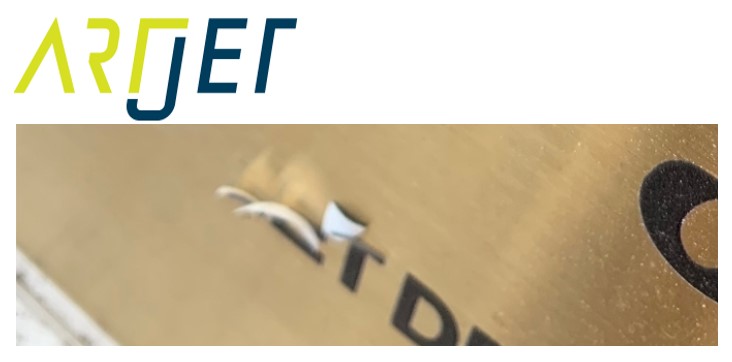
- One year after delivering the UV printer, we received a problem report about the Inkjet Primer we had sold.
- “After printing on glass, the ink that adhered well at delivery started peeling off after 6 months.”
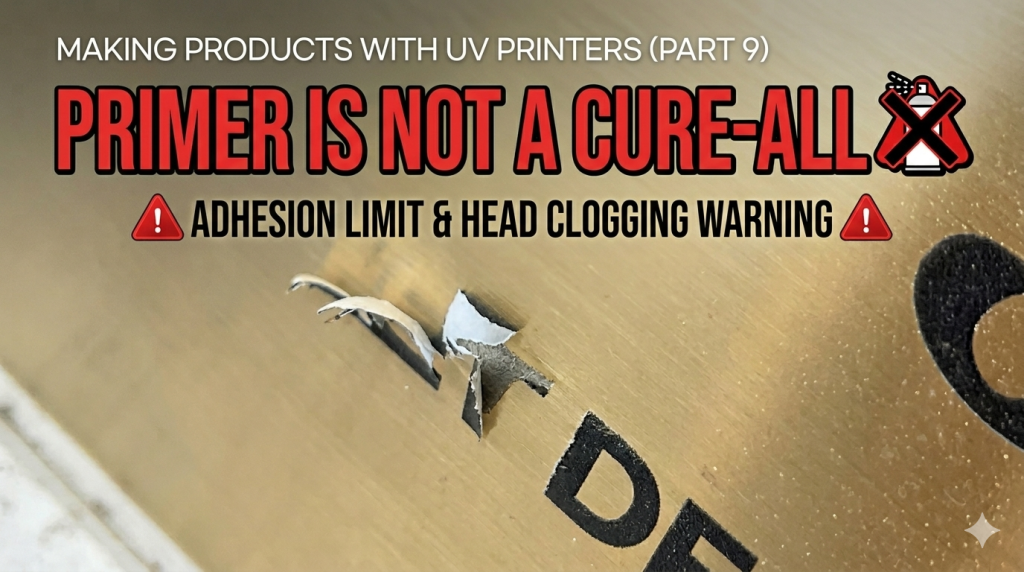
- The photo below shows output printed on a metal plate — the symptoms are similar.
-
Primer Functionality and Concerns
- While investigating the root cause, we learned about the limitations of Primer functionality — and from then on, we added a disclaimer to the Primer.
- “Primer enhances ink adhesion, but you must conduct alcohol, tape, and humidity tests on your specific substrate to determine suitability yourself.”
- Adhesion testing after printing on a substrate is typically conducted as shown in the YouTube video below.
- Primer Functionality and Limitations
- When delivering Primer-printed products, consider the post-installation environmental conditions (high humidity, high/low temperature, fluctuating conditions) and whether issues may arise after 3 or 6 months.
II. Won’t Primer Clog the Print Head? — Primer Functionality and Concerns
1. Idle Testing
- During the initial Primer development, countless print heads were discarded.
- The final Primer achieved functionality and could survive a weekend without clogging the nozzles, but:
- “Europe has long vacations — what happens if it sits idle for more than a week?”
- “Let’s set the bar at: after 2 weeks idle, if purge + cleaning can unblock the clogged nozzles — even with difficulty — we’ll consider it acceptable.”
- We achieved this level and sold the Inkjet Primer, but the complaints we kept hearing were:
- “The Primer print head is gradually clogging — after hours of purge + cleaning, the blocked nozzles simply won’t open.”
2. Preventing Head Clogging Through Automatic Cleaning
- Japanese UV printers may have better Primer ink that doesn’t clog as easily, but Japanese compact UV printers also have automatic cleaning systems.
- At set intervals, ink is purged and the print head is automatically cleaned.
- No matter how finicky the ink is, periodic automatic cleaning significantly reduces nozzle clogging issues.
- Japanese UV printers with automatic cleaning appear to have relatively stable Primer performance.
3. Is the Primer Made in China or Korea?
- I used to think this way too, but a common question from customers is:
- “Is this Korean ink? Or Chinese ink?”
- This question usually carries the implicit assumption that “Chinese = bad, Korean = better.”
- How many inkjet ink manufacturers in Korea actually have systematic quality control?
- Outside of major companies, there are fewer than you’d think.
- For companies with systematic production, one of the most critical factors is: “whether there are problems after delivery.”
- Inkjet Primer should have become mainstream by now, but it hasn’t.
- The reason is that in one form or another, “post-delivery problems” keep occurring.
- Some smaller Korean companies advertise Inkjet Primer online, but what’s concerning is that their Primer bottles list multiple print head models together.
- A single Primer claiming compatibility with multiple heads means it’s not optimized for any of them.
- Using such a product is likely to cause various issues.
4. The State of International Inkjet Primer
- Four years ago, we tested a European-made Inkjet Primer designed for the Xaar1201 print head.
- Adhesion was improved with the Primer, but over time the head clogged.
- We stopped using it because of this.
- As an additional test, we tried applying the Xaar1201 Primer to an XP600 print head.
- Voltage had to be raised excessively just to achieve marginal jetting, and too much ink scattered sideways — so we abandoned the attempt.
- This illustrates that Primer must be developed specifically for one print head to even achieve acceptable jetting — and even then, head clogging remains a concern.
- The likely reason China — despite being quick to adopt new technologies — hasn’t mass-produced Primer is the risk of post-delivery problems.
-
Primer Functionality and Concerns
-
Primer Functionality and Concerns
III. Hand-Applied Primer — Primer Functionality and Concerns
1. Japanese UV Primer
- It’s not that the Primer itself is fully stabilized — rather, thanks to the automatic cleaning system, Primer is viable on Japanese compact UV printers.
- However, whether adhesion actually works properly on metal plates or glass must be confirmed directly.
- Currently, some Chinese or Korean equipment makers claim Primer is “usable,” but stability remains to be seen.
2. Manual Primer
- Some UV printer operators use manually applied Primer liquid instead of Inkjet Primer.
- Apply Primer to the substrate with a cotton pad, UV print on top, then wipe off unprinted areas with alcohol to finish.
- However, even if you accept this inconvenience, there are additional considerations:
- A single Primer doesn’t work on all substrates — there are separate types for glass, acrylic, and metal. Primer types vary by substrate.
- One customer sourced a metal Primer from another company, applied it, and delivered to a government facility — but the ink peeled off due to summer humidity. “Just because adhesion works at the time of printing doesn’t guarantee there won’t be problems later.”
- Manually applying Primer, then wiping off unprinted areas afterward — all this labor time is a cost. Small batches can be managed, but for large volumes, factor the application time into your pricing.
- Another consideration: employees often dislike manual Primer application due to the odor and environmental concerns.
IV. ARTJET UV Printer
Having sold and serviced ARTJET UV printers for over five years, the most important lesson we’ve learned is this:
After product reliability, the most critical factor is accumulating troubleshooting data.
Any machine can develop problems depending on the environment, workload, and operator experience. What matters most in a real production setting is not “a machine that never breaks down,” but rather:
How quickly and accurately you can identify the cause and resolve the issue when something goes wrong.
ARTJET continuously collects and organizes real-world field data to support faster and more accurate problem resolution.
🎥 Print Quality Sample
💰 ARTJET Pricing & Sales Conditions
(Note: Exterior design has been updated)
🧾 Complete List of UV Printable Products

* Note: Exterior design has been updated.
※ This article is based on real field cases. Results may vary depending on your environment and machine configuration.