UV Printer History and Future Part 2 of 5
So far, I have summarized the information related to UV Printers below. If you click on the article, you will be taken to the link for related information.
24 articles on ink supply issues,
9 articles on head basics,
12 articles on actual head issues and their solutions,
10 actual mechanical Machine Problems and Solutions.
12 Problems and Solutions of Electronic Boards and SW Actually Issued
11 Problems and Solutions: Sai Rip Installation and Basic Settings, Spot Color Creation, and More
We’ve compiled a list of products that can be made with a UV printer.
Last time, we looked at how UV printer models have evolved.
Simply put, the UV printer model has changed: “Conveyor belt type => Flatbed only => Roll only => Mercury to LED.”
This time, we’ll discuss, beyond the UV printer product line, “What has happened to the UV printer manufacturers who created those products?”
I’ll explain.

I. What it will look like after the OEM and M&A _UV Printer History and Future Part 2 of 5
1. Companies that chose Chinese OEMs __ UV Printer History and Future Part 2 of 5
Vutek (USA)
- Vutek, an American company, has long been a leader in conveyor belt-type UV printers.
- It manufactured large-scale equipment directly,
- and supplied mid- to low-priced equipment as an OEM through the Chinese manufacturer Flora.
- After a certain point, Vutek was acquired by a large company called EFI.
It continues to actively operate in the market, producing high-priced equipment directly and supplying mid- to low-priced equipment through Chinese OEMs.
Fujifilm (Japan)
- Fujifilm had no UV printer manufacturing base,
- and from the outset, began selling large-scale roll-to-roll UV printers as OEMs from Nur, a major manufacturer in Israel at the time.
- A few years later, they abandoned Nur’s products and began selling large-scale roll-to-roll UV printers from JHF, a Chinese manufacturer.
Finally, they chose a Chinese OEM product and have continued to survive in the market to this day.
Roland (Japan)
- Although it had been supplying its own small models to the market,
- it eventually began manufacturing small roll-to-roll models as a Chinese OEM.
It is actively operating in the market.
2. HP. A company acquired and merged with Canon _UV Printer History and Future Part 2 of 5
Companies Acquired and Merged by HP
- In the early days of UV printers, Colorspan, Nur, and Scitex were all leading UV printer manufacturers.
- Colorspan was a groundbreaking product with excellent cost-effectiveness at the time of its launch, selling hundreds of units within a year.
- Nur and Scitex, both Israeli companies, possessed outstanding technological prowess.
- Around 2010, HP acquired all three companies almost simultaneously.
- While this was positive news, as it provided clear evidence of the UV printer market’s expansion, there were also concerns that HP was monopolizing the market.
- However, HP’s complex distribution structure meant that the same product was priced high, and for HP customer service staff accustomed to copy machines, UV printer customer service was a challenge.
In 2020, the UV printer business failed, remaining in name only. Under the motto of environmental friendliness, the company is now focusing on latex equipment.
However, the company is still active in the label and packaging markets, which are dozens of times larger than the sign market.
Acquired by Canon
- OCE was a groundbreaking company in the UV printer market.
- In 2005, it launched its first dedicated UV flatbed model, and by 2012, it had maintained a 50% share of mid-priced models, establishing itself as a leader.
- When 14pl heads were becoming popular in the market, it was the first company to use a 7pl head and grayscale to produce a product that achieved the highest image quality.
However, after being acquired by Canon, it stopped releasing new models, and, like HP, complaints spread that its customer service staff were acting like regular copiers. This led to its disappearance from the market.
Ultimately, companies that chose Chinese OEMs are still active in the market, while those acquired by global companies like HP and Canon are no longer active in the UV printer market.
II. Independently without a partner _UV Printer History and Future Part 2 of 5
1. Durst(Italy) _ UV Printer History and Future Part 2 of 5
Until 2010, you could find Durst UV printers in the largest printing offices in any European country.
Although their equipment was two to three times more expensive than comparable models, they consistently sold well.
However, in 2015, as Durst’s UV printers’ quality and speed became comparable to those of competitors, sales of UV printers began to decline.
Durst’s delayed technological development was believed to be causing it to lose market share,
but it turned out that Durst had deliberately withdrawn from the fiercely competitive UV printer market.
Instead, they focused on viable and still-active markets: tile printers, various industrial inline inkjet equipment, and label printers.
Currently, they are generating sales in these markets at levels unmatched by UV printers.
2. Mimaki(Japan)? _ UV Printer History and Future Part 2 of 5
Mimaki’s UV history is quite extensive.
At SGIA (Atlanta, USA) in 2004, they exhibited a compact model (not as compact as today’s equipment) using Mercury lamps.
In 2010, they released the current UJF series, equipped with LED lamps and as simple as a DESKTOP.
At the time, there were concerns about “what can be done at that speed?”, but contrary to expectations, within five years of its launch, it became synonymous with compact models.
I heard from a Japanese acquaintance that Mimaki underwent restructuring in 2019, but judging by its continued success, it appears they’re maintaining their independence well.
However, some of their recent models are produced in China.
III. UV Printer Players and Market _UV Printer History and Future Part 2 of 5
1. UV Printer Players _UV Printer History and Future Part 2 of 5
Companies acquired by global giants like HP and Canon naturally disappeared from the market as their UV printer divisions weakened.
AGFA, a company that chose Korean manufacturers as OEM partners, also saw sales decline and naturally disappeared from the market as Korean manufacturing competitiveness waned.
Ultimately, the only companies still playing in the UV printer market are those that
- chose Chinese companies as OEM partners.
- And these are the only Chinese companies. Chinese products now account for 80% of the market.
2. Current UV printer market_ UV Printer History and Future Part 2 of 5
Even from a global company’s perspective, UV printers were a very small market, so looking back, it seems they may have strategically withdrawn from the market by reducing investment.
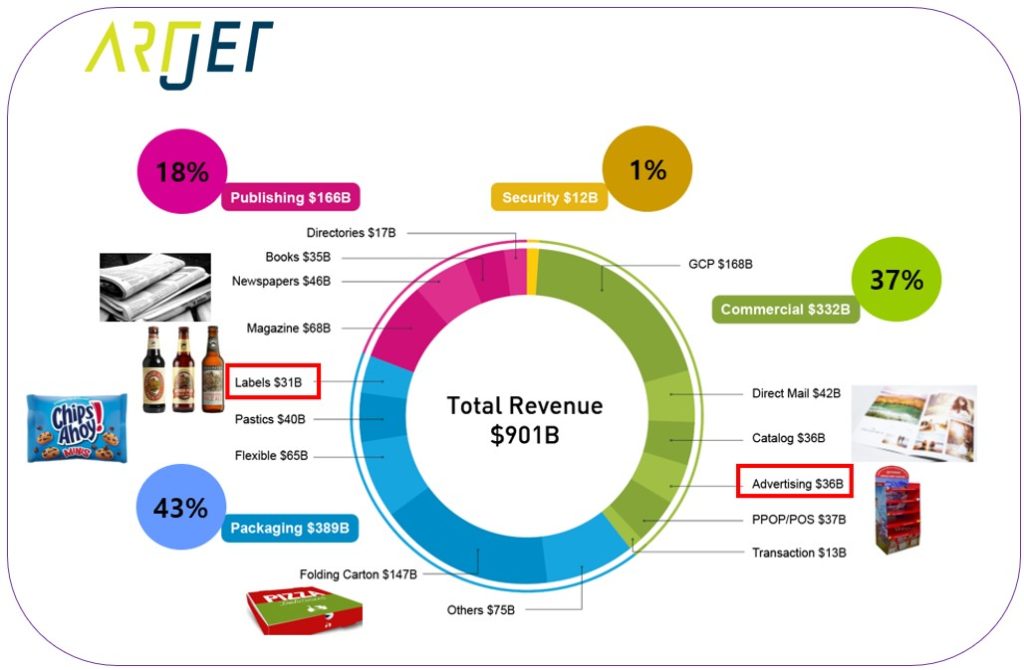
- As shown in the table below, the entire signage market is approximately $36 billion, representing about 10% of the $390 trillion ($389 trillion) packaging market.
- Within the packaging market, the label market alone is worth $31 billion, similar to the overall signage market.
- It seems more accurate to say that major companies like HP, Canon, EFI, and Durst have not been driven out of the signage market,
- but rather have moved away from the smaller signage market and into the label & packaging market.
As a counterpoint to this,
- according to our Chinese partners, UV printer sales margins have vanished for quite some time,
- and most major inkjet manufacturers have long since turned their attention to other markets.

3. As a result _UV Printer History and Future Part 2 of 5
UV printers available in the sign market are manufactured exclusively in China and Japan.
In particular, since over 80% of UV printers are manufactured in China, we believe that examining the current situation faced by Chinese manufacturers and the strategies they have adopted to overcome this situation will provide answers to our topic, “The History of UV Printers and Future Forecasts.”
Next time, we will examine the current state of Chinese manufacturers and forecast their future.
IV. This is how ARTJET supports our customers.
One thing I feel while selling and maintaining ARTJET UV Printers for 5 years is that the next most important thing after product stability is Troubleshooting DATA.
All products have problems, whether they are actual equipment problems or consumer errors, and product stability is how easily and quickly you solve those problems.
We are organizing all the troubleshooting DATA as follows.
You can see the product print quality by clicking here.

1. Additional information on printhead problems
Please refer to the information summarized above, and the additional information summarized below is as follows.
Addition
“After connecting the DATA Cable, one channel is not fired”
2. Additional information on ink supply issues
Please refer to the information summarized above, and the additional information summarized below is as follows.
Addition
“no clogged nozzles, but banding in the red ARTJET 2025”
“When I print it, the whole thing has a yellow tint to it”
3. Additional problems due to equipment problems or management negligence
Please refer to the information summarized above, and the additional information summarized below is as follows.
“I see a white line after 600mm on the Y-axis.”
4. Additional information on Electron board and Software issues
Please refer to the information summarized above, and there is no additional information summarized yet.
5. Additional information on Sai Flexi Rip software
Please refer to the information summarized above, and there is no additional information summarized yet.
6. Problems and solutions from actual consumer sites
1. Paper that absorbs ink
2. A line-like thing appears at the end of the white print surface
3.Can varnish banding be reduced?
4. Are there many problems with China’s UV Printer?
7. UV Printer Application
Please refer to the information summarized above, and there is no additional information summarized yet.
8. Bonus
1. UV Printer Old Model Refurbished _updated
2. UV Printer Laser Cutter Bonding Machine Which equipment should I buy first? _updated
3. Considerations when choosing a UV printer _updated
4. DTF Printer Price and Specification Survey_updated
5. Acrylic Bonding Equipment Don’t Put It Off Anymore
6. China inkjet level now_updated
7. Thoughts on KOSIGN 2024_updated
8. ARTJET Delivery Preparation
9. ARTJET Setting Sequence
10. UV Printer History and Future Prediction 1
11. UV Printer History and Future Prediction 2
12. UV Printer History and Future Prediction 3
13. UV Printer History and Future Prediction 4
14. UV Printer History and Future Prediction 5
15. Are there many problems with China’s UV Printer?
16. UV Printer Small Text Meaning
17. Is the XP600 head okay
18. Roland UV Printer Summary
19. Mimaki UV Printer Summary
20. UV Printer Alibaba Direct Purchase Considerations
21. Things to consider when buying a used UV Printer
22. Bi Uni Print Quality Differences
23. RDworks download install and laser head position by SW
That’s it for today.