
UV Printer History and Future Part 1 of 5
So far, I have summarized the information related to UV Printers below. If you click on the article, you will be taken to the link for related information.
24 articles on ink supply issues,
9 articles on head basics,
12 articles on actual head issues and their solutions,
10 actual mechanical Machine Problems and Solutions.
12 Problems and Solutions of Electronic Boards and SW Actually Issued
11 Problems and Solutions: Sai Rip Installation and Basic Settings, Spot Color Creation, and More
We’ve compiled a list of products that can be made with a UV printer.
Today, we’ll be discussing the history and future of UV printers, and this is part 1 of 5.
I. Background information_UV Printer History and Future Part 1 of 5
To briefly explain my career, from 2003 to 2019, I worked in sales and marketing at Inkjet, a manufacturer of UV printers.
I’ve been selling and maintaining ARTJET UV printers.
While working in overseas sales, I’ve naturally observed the UV printer market.
I’ll take some time to summarize what I’ve observed and predict how the market will evolve in the future.
The first topic will be, “How have UV printer manufacturers evolved from the 2000s to 2020?”
The second topic will be, “Who are the main players in the InkJet market?”
In the third part, I’ll predict how these main players are preparing for the future market.
Refer to the table below to examine how the product line has evolved.

II. This wasn’t the first UV printer specifically for flatbed printing _UV Printer History and Future Part 1 of 5
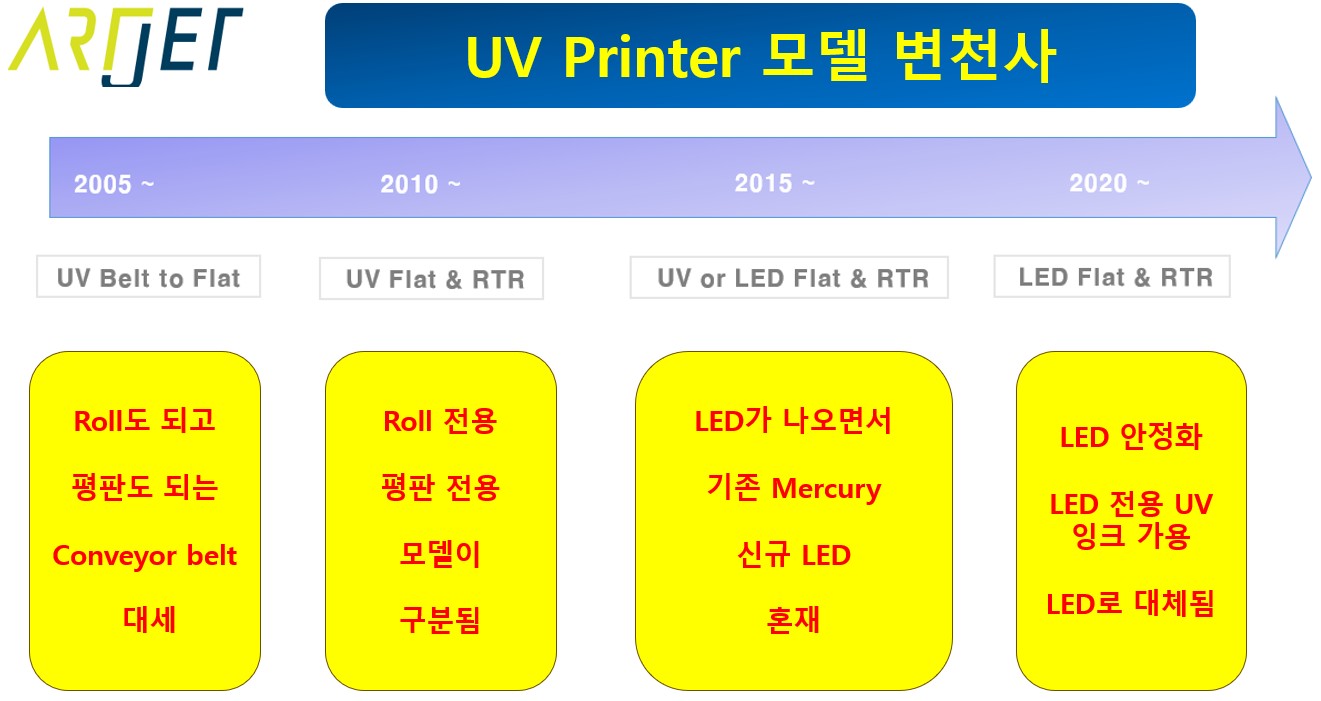
1. Hybrid printing on both rolls and flat surfaces_UV Printer History and Future Part 1 of 5
Until 2005, the main type of printer was a conveyor belt type, capable of printing on both roll and flatbed media.
The manufacturers were:
- Vutek, now EFI.
- Zund, currently sells cutters but was a leading manufacturer of UV printers.
- Durst, currently supplies labels and industrial inkjets.
The advantage of using a conveyor belt is that the flatbed is limited only by width, allowing unlimited printing lengthwise.
However, the unlimited length makes it difficult to align the material (a 1mm error at the start of printing when loading the material can result in a 1cm difference at the 2m mark), making it inconvenient to use.
In the early days of UV printers, a plate cap cost 200-400 million won.
Because the equipment was so expensive, customers often thought:
“This expensive equipment should be able to print on both rolls and flatbeds! Why would anyone buy a machine that only prints on flatbeds?”
2. Separate for roll and reputation _UV Printer History and Future Part 1 of 5
At the time, the 25pl print head from Spectra, a subsidiary of Fuji Dimatix, dominated the market with the highest resolution.
Konica Minolta introduced a 14pl head and dominated the market for about two to three years.
But that was short-lived. In 2006, OCE introduced a flatbed printer equipped with a 7pl head, changing the landscape.
Conveyor belt-type printers, driven by large rolls, suffered from belt slip and poor Y-axis precision.
However, flatbed printers equipped with a liner scale on the Y-axis improved Y-axis precision and,
provided the highest quality by jetting 7pl ink droplets.
Following the OCE model, other manufacturers also began releasing flatbed-type printers, surpassing conveyor belt-type UV printers.
For a while, conveyor belt-type UV printers and flatbed-specific UV printers coexisted.
For a while, consumers also began to believe that belt-type printers, which can be used both on rolls and flatbeds, had limited print quality.
Nearly all manufacturers began introducing 2513 (4×8 ft) flatbed printers.
In 2010, market leaders like OCE began releasing roll-only UV printers.
However, the roll-type market was still well-suited to solvent-only printers, so roll-type UV printers remained relatively unpopular.
3. Bonus: Print Quality Comparison _UV Printer History and Future Part 1 of 5
In 2007, I compared the quality of the same image printed on a 6-color 14pl conveyor belt printer with a 7pl 4-color (grayscale) flatbed printer at Viscom in Italy.
At the time, I was a salesperson selling 14pl 6-color conveyor equipment and had to witness a customer choose OCE products.
- The difference in gab between 6-color and 4-color inks couldn’t overcome the maximum resolution achievable with 14pl and 7pl ink droplets.
- The Y-axis feeding precision also fell short of that of a flatbed printer.
- At the time, Variable Dot technology was new to the industry and unfamiliar to us.
If you’re curious about Variable Dot technology, please refer to the information below.
Ultimately, print quality was poor:
- large ink drops couldn’t keep up with small drops,
- single drops couldn’t keep up with multi-drops,
- and belt-type printers couldn’t match flatbed-only printers in Y-axis precision.
For this reason, belt-type printers fell behind flatbed-only printers in purchasing criteria for UV printers.
III. UV(mercury)=> LED_UV Printer History and Future Part 1 of 5
1. Difference between Mercury UV and LED_UV Printer History and Future Part 1 of 5
Mercury lamps had several drawbacks.
- Mercury UV lamps consumed significant power. Because of this, consumers who purchased UV printers had to perform separate electrical work.
- Furthermore, Mercury lamps generated significant heat, causing the material to warp during printing, often hitting the print head. Depending on the material, double-sided tape or other measures were required to print.
- Furthermore, materials sensitive to heat could not be printed at all.
However, despite the shortcomings of Mercury lamps, they didn’t immediately transition to LED lamps.
- During the early stages of LED lamp development, they were primarily developed in the UK and the US, and were expensive, 1.5 to 2 times more expensive than Mercury lamps.
- Ink optimized for LED lamps was still in its infancy.
2. Transform in an instant_UV Printer History and Future Part 1 of 5
Starting in 2015, high-end UV printers, i.e., expensive equipment, began to install LEDs instead of Mercury lamps.
LED lamps, once exclusive to high-end equipment, were briefly adopted. However, with the development of LEDs in Taiwan and China, prices dropped, and within one to two years, most manufacturers switched to LEDs.
Rapid Popularization of LED Lamps
- The switch to LEDs was expected to be difficult due to concerns about poor ink adhesion and the high price of LED lamps.
- However, within two years of installation, nearly all UV printer manufacturers adopted them.
- Taiwan and China drastically reduced prices,
- and LED inks compatible with the inks developed in Taiwan and China quickly became widely available. This led to LED lamps becoming mainstream in less than two years.
Today, I discussed the UV printer product flow.
- Mechanical changes include the shift from belt-type to flatbed or roll-type UV printers,
- and the transition from mercury lamps to LED lamps.
Next time, I’ll discuss how UV printer manufacturers have changed since 2005.
You can also watch the YouTube video below to learn more about what I discussed today.
IV. This is how ARTJET supports our customers.
One thing I feel while selling and maintaining ARTJET UV Printers for 5 years is that the next most important thing after product stability is Troubleshooting DATA.
All products have problems, whether they are actual equipment problems or consumer errors, and product stability is how easily and quickly you solve those problems.
We are organizing all the troubleshooting DATA as follows.
You can see the product print quality by clicking here.

1. Additional information on printhead problems
Please refer to the information summarized above, and the additional information summarized below is as follows.
Addition
“After connecting the DATA Cable, one channel is not fired”
2. Additional information on ink supply issues
Please refer to the information summarized above, and the additional information summarized below is as follows.
Addition
“no clogged nozzles, but banding in the red ARTJET 2025”
“When I print it, the whole thing has a yellow tint to it”
3. Additional problems due to equipment problems or management negligence
Please refer to the information summarized above, and the additional information summarized below is as follows.
“I see a white line after 600mm on the Y-axis.”
4. Additional information on Electron board and Software issues
Please refer to the information summarized above, and there is no additional information summarized yet.
5. Additional information on Sai Flexi Rip software
Please refer to the information summarized above, and there is no additional information summarized yet.
6. Problems and solutions from actual consumer sites
1. Paper that absorbs ink
2. A line-like thing appears at the end of the white print surface
3.Can varnish banding be reduced?
4. Are there many problems with China’s UV Printer?
7. UV Printer Application
Please refer to the information summarized above, and there is no additional information summarized yet.
8. Bonus
1. UV Printer Old Model Refurbished _updated
2. UV Printer Laser Cutter Bonding Machine Which equipment should I buy first? _updated
3. Considerations when choosing a UV printer _updated
4. DTF Printer Price and Specification Survey_updated
5. Acrylic Bonding Equipment Don’t Put It Off Anymore
6. China inkjet level now_updated
7. Thoughts on KOSIGN 2024_updated
8. ARTJET Delivery Preparation
9. ARTJET Setting Sequence
10. UV Printer History and Future Prediction 1
11. UV Printer History and Future Prediction 2
12. UV Printer History and Future Prediction 3
13. UV Printer History and Future Prediction 4
14. UV Printer History and Future Prediction 5
15. Are there many problems with China’s UV Printer?
16. UV Printer Small Text Meaning
17. Is the XP600 head okay
18. Roland UV Printer Summary
19. Mimaki UV Printer Summary
20. UV Printer Alibaba Direct Purchase Considerations
21. Things to consider when buying a used UV Printer
22. Bi Uni Print Quality Differences
23. RDworks download install and laser head position by SW
That’s it for today.