Do Not Print on Masks — UV Printer Products Part 5
✅ Who should read this?
- Anyone considering UV printing on face masks
- Anyone curious whether UV printing is possible on fabric (textile) substrates
- Anyone who wants to understand the UV printing difference between coated and uncoated fabric
- Anyone experiencing issues with porous substrates not being held down on the flatbed
- Print shop operators who have received UV printing requests for fabric materials like canvas
⚠️ Caution (Protecting High-Cost Components)
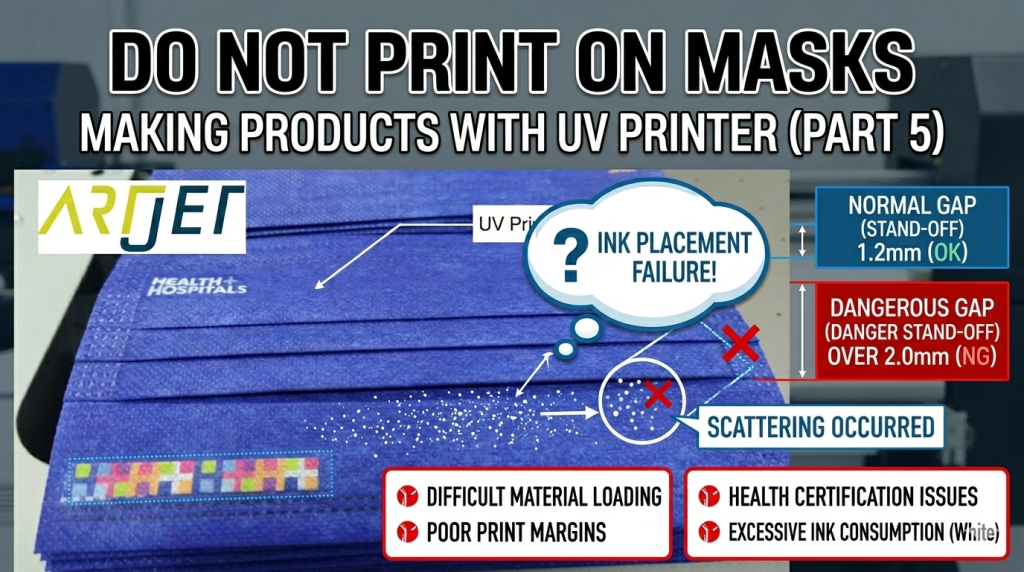
- Do not print on respiratory masks with UV ink. This is strongly advised against for safety reasons.
- Masks are porous substrates — vacuum or fan suction cannot hold them flat on the flatbed. The substrate may shift during printing or warp from LED heat and strike the print head.
- Uncoated fabric absorbs ink immediately, making proper color reproduction impossible. White ink must be printed twice (1200%) just to barely cover the base color.
- When receiving UV printing requests for fabric, always verify whether the fabric is coated first. Coating determines whether UV printing is feasible.
🧭 Key Summary (Field Checklist)
- UV printing on masks is not recommended due to safety concerns + flatbed adhesion failure + poor color output.
- Porous substrates cannot be held by vacuum/fan — workarounds like transparent PET film are needed.
- Uncoated fabric absorbs ink, resulting in poor color. Even White at 1200% (2 passes) barely covers the base.
- When receiving fabric UV printing orders, confirming coating is mandatory — only coated fabric works with UV ink.
- Large-format UV printers can print on canvas, but ink absorption and color vary depending on the coating type.
📋 UV Printer Products Series — Full Article List
We are documenting UV printer product manufacturing methods in order. This list will be updated as new articles are added.
We are covering the various products you can make with a UV printer.
Today, we explain why UV printing on masks should not be done.
I. Problems When Printing on Masks — Do Not Print on Masks
1. The Problem of Securing Masks on the Flatbed
- For UV printing, the substrate placed on the flatbed must remain completely flat.
- Otherwise, the 1.2 mm stand-off cannot be maintained, which can cause print defects.
- This is why the flatbed uses vacuum suction from below or fans to draw air downward to hold the substrate in place.
- Both methods use vacuum or airflow to hold the substrate — so when the substrate is porous, the holding force weakens significantly.
- When the holding force is weak, the substrate may shift during printing, or LED heat may cause it to warp and strike the print head.
- Masks are inherently porous for breathing purposes — UV printer vacuum or fan suction simply cannot hold them down.
- Because of this, alternative methods must be devised to secure masks on the flatbed.
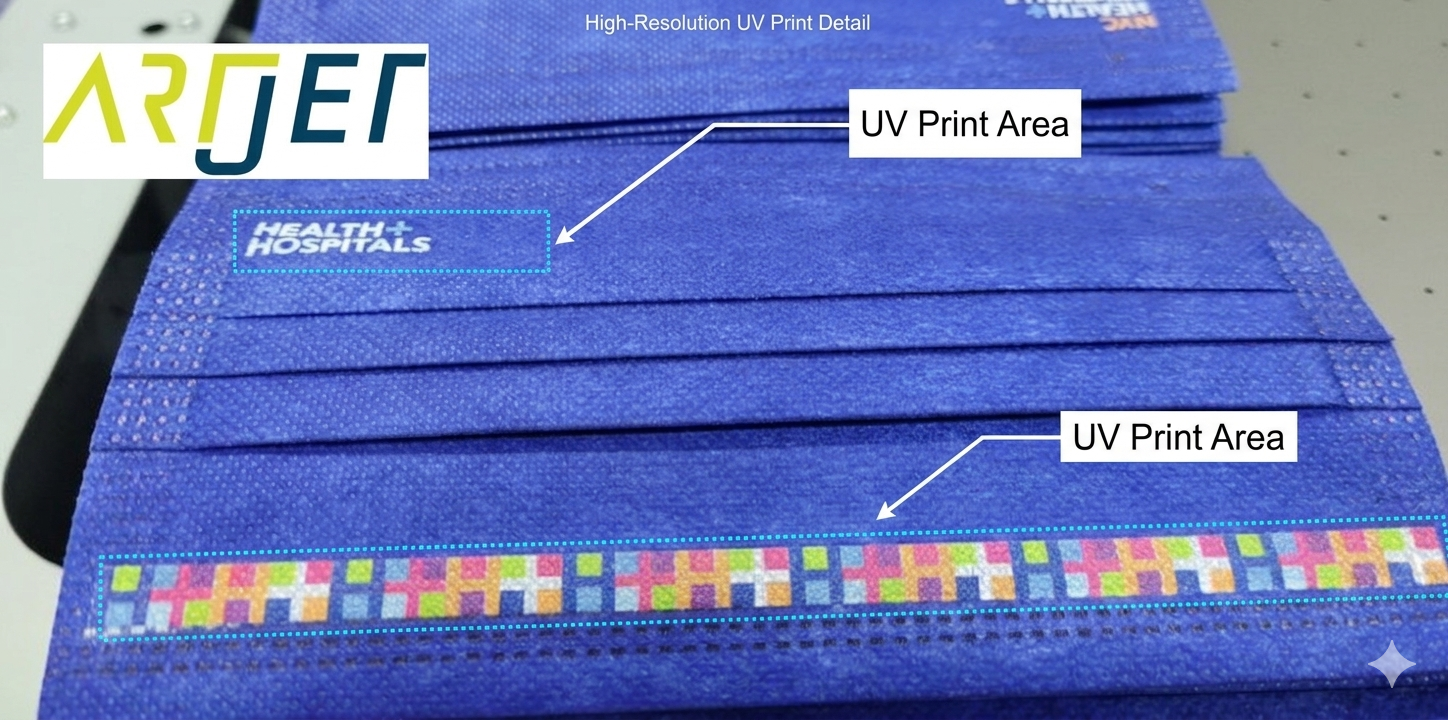
- After considering various approaches, we used a transparent PET film to cover the mask except for the printing area, allowing it to be held by flatbed suction.
- Maintaining a perfectly flat surface was difficult, but we achieved enough flatness to proceed with printing.
2. Uncoated Fabric
- When UV printing on ordinary fabric, the ink is absorbed into the material immediately upon landing — making proper color reproduction impossible.
- Since masks are also fabric, the ink was absorbed and UV printing could not produce accurate colors.
- We printed White first and then Color on top, but a single White pass was insufficient (6 channels × 100% = 600%) — we needed two passes (1200%) to barely cover the blue base color.
- When receiving UV printing requests for ordinary fabric in the future, you must always verify whether the fabric is coated.
- Uncoated fabric like masks does not work well with UV printing, while coated fabric does not absorb ink and is suitable for UV printing.
- Additionally, masks themselves are low-cost items with low print pricing — considering the high White ink consumption, the margins are not favorable.
3. Safety Concerns
- Most critically, printing UV ink on masks — which are worn directly over the respiratory system — should not be done.
Do Not Print on Masks
II. Fabrics That Are Actually Being Printed — Do Not Print on Masks
Operators with large-format UV printers do actually print on fabric.
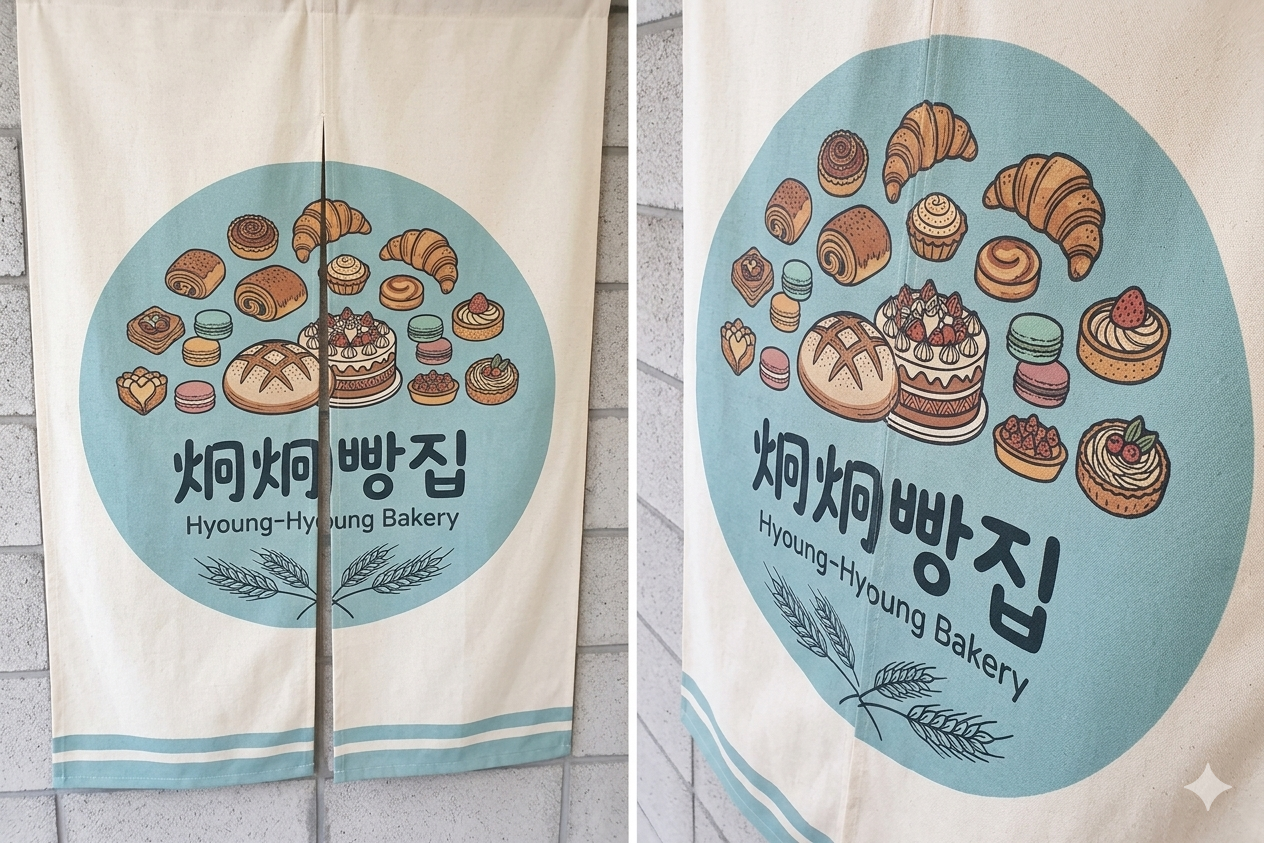
They typically use canvas (cotton duck fabric), primarily for advertising purposes.
You also need to find canvas that is suitable for UV printing yourself.
Depending on what type of coating the canvas has:
- UV printability is determined,
- color reproduction varies slightly, and
- ink absorption rates differ.
Do Not Print on Masks
III. UV Printer Basics · Troubleshooting · Printable Products
All UV Printer content has been organized below. Click any item to go directly to that article.
1) Ink Supply
23 articles on print errors caused by ink supply issues including cleaning and pumping
2) Print Head Issues
12 articles covering everything from head replacement to head-related problems
Want to study print heads in depth: Print Head Basics — 9 Articles
3) Electronics / Software Issues
4) Mechanical Issues
5) Sai Rip Installation, Spot Color, and Troubleshooting
IV. ARTJET UV Printer
Having sold and serviced ARTJET UV printers for over five years, the most important lesson we’ve learned is this:
After product reliability, the most critical factor is accumulating troubleshooting data.
Any machine can develop problems depending on the environment, workload, and operator experience. What matters most in a real production setting is not “a machine that never breaks down,” but rather:
How quickly and accurately you can identify the cause and resolve the issue when something goes wrong.
ARTJET continuously collects and organizes real-world field data to support faster and more accurate problem resolution.
🎥 Print Quality Sample
💰 ARTJET Pricing & Sales Conditions
(Note: Exterior design has been updated)
🧾 Complete List of UV Printable Products

* Note: Exterior design has been updated.
※ This article is based on real field cases. Results may vary depending on your environment and machine configuration.
핑백: How to Print on Slanted Substrates