Can I print on reflective material ?_Head related issues 4 _ ARTJET 2026
📌 Who Should Read This Article
This article is written for UV printer operators, maintenance engineers, print shop owners,
and engineers designing UV printer systems working with reflective or tall materials.
If you have ever asked:
“Can I safely print on reflective materials?”
“Why did my printhead suddenly clog?”
— this article is for you.
⚠️ Important Warning
Printing on reflective or tall materials can permanently damage printheads if proper precautions are not taken.
- UV reflection can cure ink inside the nozzle
- Sudden full head clogging can occur
- Head lifespan can be dramatically reduced
- Expensive head replacement may be required
🧭 What This Article Covers
- Real accident cases from field experience
- How UV light reflection damages printheads
- Why tall materials can be more dangerous than mirrors
- Manufacturer-level technical advice
- Practical prevention methods you can apply immediately
❗ Key Concept
Reflective materials are dangerous.
But large head gaps (high standoff) can be even more dangerous.
So far, I have summarized the information related to UV Printers below. If you click on the article, you will be taken to the link for related information.
- 9 articles on head basics,
- 12 articles on actual head issues and their solutions,
- 10 actual mechanical Machine Problems and Solutions.
- 12 Problems and Solutions of Electronic Boards and SW Actually Issued
- 11 Problems and Solutions: Sai Rip Installation and Basic Settings, Spot Color Creation, and More
- We’ve compiled a list of products that can be made with a UV printer.
If cleaning, pumping, or printing is not working properly, there are two approaches you can take:
1. Ink supply
- Printing errors caused by ink supply (including cleaning and pumping issues) have been recently updated.
- For printers using dampers, troubleshooting can be done through the link below.
- This is a table of contents, with 23 articles, complete with photos and explanations. Click on the link to view the relevant articles.
- Printer Cleaning Problems Part 23 Table of Contents ARTJET 2026
2. DATA-related issues (electronic board, head, DATA cable, etc.). Currently updating.
- In the first session, the symptoms and solutions that occur when a DATA cable becomes contaminated with ink.
- In the second session, the 17 used heads I had in storage, how many were usable after cleaning them with alcohol, and what errors occurred.
- In the third hour, I discussed the issue of certain colors being printed strangely during printing.
Today, we’ll be discussing the risks of printing on reflective materials like glass and mirrors, and how to avoid these risks.
I. Two major accidents _Can I print on reflective material ?
1. When I was working for a large UV Printer manufacturer
This incident occurred while I was working at a large UV printer manufacturer for 11 years.
- The model sold in 2015 was a 2.5 x 3.2 meter large UV printer equipped with 16 KM1024 heads.
- The price of the 16 heads alone was around 30 million won.
- I was working in the office when a friend who was doing repairs suddenly appeared with a surprised expression on his face.
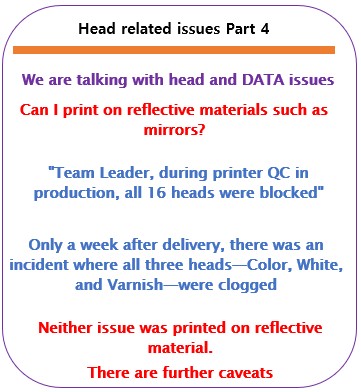
“Team Leader, during a QC test on the printer in production, all 16 heads got clogged.”
“How much does one head cost? What did they do to cause this?”
“They said they were testing the head carriage movement, so they left it running in test mode for three hours, with the lamps on, and the head height set to 50mm.”
“If anyone had seen it, they would have definitely warned us about the problem,”
“They did, but they said there were no problems the last time they ran it for about two hours, so they just kept going.”
“When a certain critical point is reached, the head nozzles suddenly clog, so that must have happened.”
All 16 heads were blocked, even though they weren’t printing on reflective materials like glass or mirrors.
I’ll explain later why the heads suddenly became blocked, even though I wasn’t printing on reflective materials like mirrors.
2. After delivery of small UV printer in early 2020
Less than a week after delivery, we received a complaint that all three heads were not loading (pumping) and no ink was coming out.
Thinking it was a pumping issue, we performed various checks, but no matter what we did, the pumping wouldn’t work.
It had only been a week since delivery, but the pumping wouldn’t work, so we wondered, “Could the heads be clogged?”
We replaced only one head, and it pumped right back up.
After asking the customer, they said they had been printing on a 70 mm-tall material all day, and that was when the print head issues began.
The material was a painted steel plate.
II. Printhead Manufacturer Advice _Can I print on reflective material ?
My first job, in 2004, was at a UV printer development company. At the time, dedicated UV ink heads and UV ink were in their infancy.
The head used in my first development model in 2004 was from Konica Minolta, and I frequently met with Konica engineers to discuss technical issues.
One topic during these technical meetings was head nozzle clogging caused by the UV lamp.
Konica, which sold its heads to multiple manufacturers, offered the following advice:
1. “When building a printer, avoid using reflective materials for the head carriage transport mechanism.”
- The head carriage transport mechanism should not use SUS metal, or other highly reflective materials. If used, paint it black or other materials to prevent UV light from reflecting.
- One UV printer manufacturer experienced a problem where nozzles in specific areas were repeatedly clogged.
- The cause was the use of silver round bolts in the head carriage transport mechanism. These round bolts reflected UV light, causing it to continuously reflect on specific nozzles in the head.
- Over time, these nozzles continued to clog.
2. “The farther away from the print head the UV (LED) lamp is, the better.”
- During printing, the head carriage moves, reflecting UV (LED) light through the flatbed.
- If the head and lamp are close together, the reflected light will reach the print head.
- For this reason, the farther away the UV (LED) lamp is from the print head, the less likely it is that the reflected UV (LED) light will reach the print head.
3. “Incline the UV (LED) lamp.”
- It’s best to angle the UV (LED) lamp slightly outward from the printhead, rather than vertically.
- Because the light reflects outward, the likelihood of UV light hitting the printhead during printing is reduced.
4. “If possible, avoid reflective materials such as glass, mirrors, and metal plates. However, if printing is unavoidable,
- perform regular head cleaning after printing.
- To minimize UV (LED) lamp light reflection, when printing on tall materials, place a dummy material of the same height or slightly lower next to the material to minimize UV (LED) light reflection.
- If the print head is used above the standoff (the gap between the material and the print head, typically 1.2 mm), ink will fly off during printing, and these fine ink particles will adhere to the head nozzle.
- Continuous exposure to UV (LED) light will partially block the nozzle surface, ultimately clogging the nozzle completely.
- If a high standoff is required, perform regular head cleaning.
III. Apply Konica’s advice to your printer now _Can I print on reflective material ?
1. “When building a printer, avoid using reflective materials for the head carriage transport mechanism.”
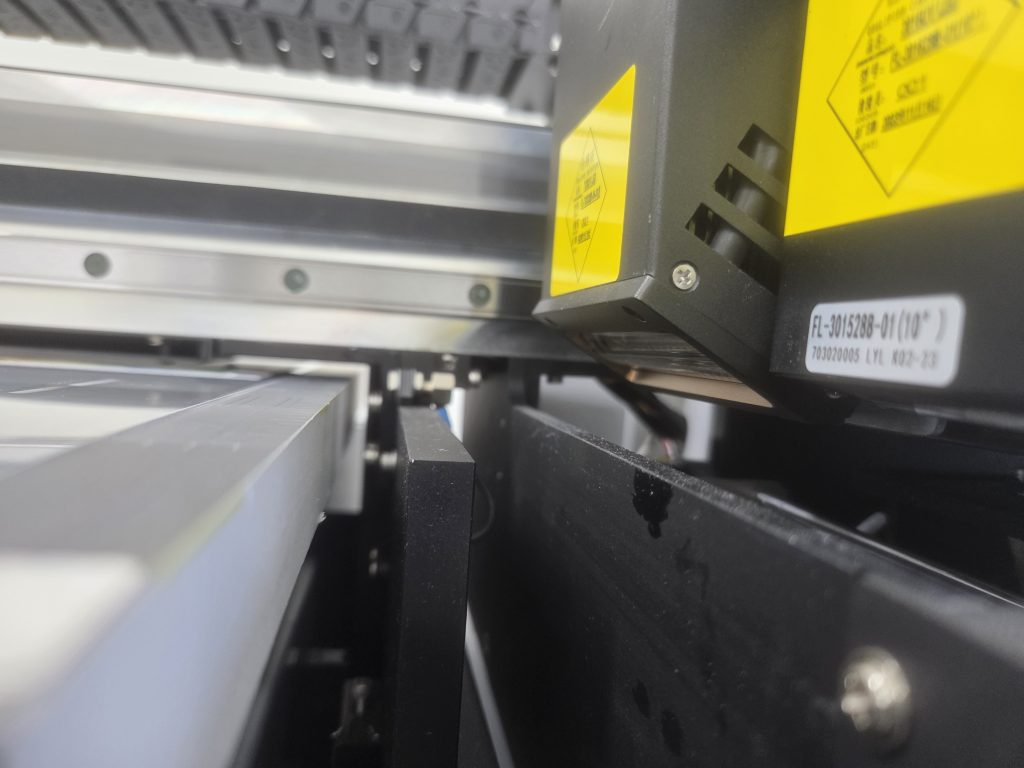
- There is no SUS Metal material that can reflect UV (LED) light around the print head carriage.
2. “The farther away from the print head the UV (LED) lamp is, the better.”
- There is a print head collision prevention device between the LED lamp and the print head, so the gap between the LED lamp and the print head is okay.

3. “Incline the UV (LED) lamp.”
- The lamp itself is also tilted about 20 degrees away from the print head.
IV Advice from someone who has been selling UV printers for over 20 years. _Can I print on reflective material ?
1. Things to keep in mind when using light-reflective materials
When printing on highly reflective materials such as glass mirrors, clean the nozzle periodically (every 30 minutes or hour).
- UV ink cures under UV light.
- However, it doesn’t cure immediately; it requires a certain amount of accumulated UV light to begin curing.
- If you print on reflective materials like glass mirrors without cleaning, the accumulated UV light will cause the ink stuck around the print head to harden slowly or suddenly.
- The problem is that UV ink contains a photoactivator. Once the ink begins to harden, it triggers a chain reaction that hardens the ink inside the nozzle.
- This prevents the nozzle from being clogged even after cleaning.
This is especially true when printing only color on reflective materials for an extended period of time, without printing varnish or white.
- Printing only color on reflective materials is less dangerous because the color ink continues to jet.
- However, since unprinted Varnish and White ink do not jet, UV light continuously hits the ink remaining in the nozzles.
- Unused Varnish and White are more dangerous than Color, so all heads must be cleaned periodically.
2. More dangerous than light reflective materials
Most UV printer users know that reflective materials like mirrors are dangerous.
For this reason, they sometimes get asked, “Can I print on mirrors?”
However, printing on tall materials is even more dangerous than reflective materials.
- When printing on a 70mm-tall wooden box,
- when the head carriage passes the print surface, the head is approximately 70mm above the floor.
- This 70mm height difference increases the angle of light reflection, causing the LED light to continuously hit the underside of the print head.
- Both major accidents, as explained at the beginning of this article, were caused by a high gap, rather than reflective materials like glass or SUS metal.
- When printing on tall materials, always place a material next to the print head that is the same height or slightly lower than the print material.
For this reason, if the head is partially or completely clogged, there is no other way than replacing the head.
For reference, please refer to the link below for instructions on how to replace the head.
V. ARTJET UV Printer
One thing I’ve noticed after five years of sales and maintenance of ARTJET UV printers is that troubleshooting data is second only to product stability.
All products have issues, whether they’re caused by actual equipment problems or consumer error. Product stability hinges on how quickly and easily you can resolve those issues.
ARTJET compiles all troubleshooting data.
You can see the product print quality by clicking here.
Click here for ARTJET pricing and terms of sale. The exterior design has changed.

핑백: Recovering a UV White Print Head After 1 Month Idle (Real Field Case, XP600)